



The legendary Italian tenor has captivated the world with his extraordinary voice. But his commitment to children living in poverty offers a profound lesson about greatness, human dignity and the moral responsibility of global fame.
By Bankole Thompson
Nationally Acclaimed Journalist, Author and Public Intellectual
For years, I have attended the concerts of Andrea Bocelli, the legendary Italian tenor whose extraordinary voice has made him one of the most celebrated musical artists of our time.
He is one of my favorite tenors.
Last year, I had the opportunity to meet Bocelli backstage at Little Caesars Arena in downtown Detroit before his concert. It was a memorable encounter with an artist whose music I have long admired.
But what has deepened my admiration for Bocelli over the years is something far more consequential than his extraordinary musical gifts. It is his commitment to children living on the margins of society.
Through the Andrea Bocelli Foundation, the globally celebrated tenor has chosen to use his fame, influence, and resources to expand opportunities for marginalized children whose circumstances often deny them the chance to realize their potential.
The ultimate measure of greatness cannot be confined to the applause we receive, the wealth we accumulate, or the honors society bestows upon us. It must also be found in what we do with our gifts when confronted by the suffering and exclusion of others.
Bocelli has spent his career giving the world his voice. Through his foundation, he is helping children discover theirs. That may prove to be among the most consequential dimensions of his legacy.
Established in 2011, the Andrea Bocelli Foundation has developed a substantial international humanitarian presence, working to expand educational opportunities, improve living conditions and strengthen communities facing profound social and economic challenges.
According to figures published by the foundation, its programs have reached approximately 4.47 million beneficiaries across 27 locations, with more than €49 million in cumulative funds allocated to its work. These figures encompass the foundation’s broader humanitarian initiatives, not simply its music programs. Numbers of that magnitude deserve attention. But the moral significance of the foundation cannot be understood through statistics alone.
Behind those numbers are children whose futures are being shaped by circumstances they did not choose. A child born into poverty does not lack intelligence because the family lacks money. A child growing up amid violence does not lack imagination because the surrounding community lacks security. And a child denied access to education does not lack potential because society has failed to provide the means to develop it.
Poverty is not simply a shortage of material resources. It is too often the systematic deprivation of human possibility. That is why Bocelli’s humanitarian work deserves serious examination. Consider the foundation’s ABF Voices Of initiative, which uses music and education to support children and young people in vulnerable communities. According to the foundation, this program has reached more than 13,000 beneficiaries, with approximately €3.07 million allocated across six project locations.
In Haiti, Uganda, Italy and the Holy Land, the initiative creates opportunities for young people to develop discipline, confidence, cooperation and cultural understanding.
In Haiti’s Cité Soleil, where poverty, insecurity and violence threaten childhood itself, the foundation’s choir initiative offers a structured environment for learning, belonging, and personal development.

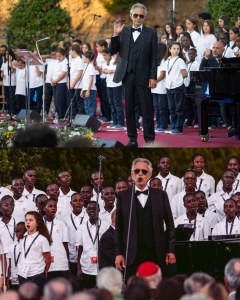
For a child growing up in such circumstances, the opportunity to sing in a choir is not merely an extracurricular activity. It can become an affirmation that the child’s existence matters, that individual talent deserves cultivation and that the future need not be permanently imprisoned by the conditions of the present.
Music cannot replace food, housing, healthcare, or economic opportunity. Nor can philanthropy substitute for governments fulfilling their obligations to vulnerable citizens.
But music can help restore something poverty frequently assaults: the conviction that one’s life possesses inherent worth. And that conviction is indispensable to human development.
In July, the foundation organized its first international ABF Voices Of Global Gathering in Italy, bringing together more than 170 young singers for a program spanning Tuscany and Rome. Children from different cultures participated in educational activities, rehearsals, and intercultural exchanges, with Haitian choir leaders representing their community because insecurity prevented its young singers from traveling.
The gathering also included an encounter with Pope Leo XIV, who welcomed young singers from Uganda, the Holy Land and Italy at Castel Gandolfo.
There was something profoundly significant about children from vulnerable communities sharing a stage with one of the world’s most accomplished tenors. But the greater significance was not the performance. It was the declaration embodied in that gathering and that is the fact that children whose lives are marked by disadvantage deserve access to the same cultural enrichment, encouragement, and possibilities that more privileged children often take for granted.
A just society does not demand that the poor surrender their dignity to receive assistance. It recognizes their dignity as the very reason opportunity and structural change are necessary.
That is the difference between charity that merely responds to suffering and justice that seeks to transform the conditions producing it. This is a distinction that would have resonated with the moral philosophy of Dr. Martin Luther King Jr., who understood that compassion for the poor must be accompanied by a commitment to confronting the structures that perpetuate poverty.
King’s moral vision was never confined to individual acts of generosity. It demanded a society in which human dignity was not determined by wealth, race, birthplace, or social standing.
That vision remains unfinished. And it challenges us to ask whether those who possess extraordinary influence will use it merely to advance their own success or to expand the possibilities of others.
Bocelli offers one compelling answer: children should not be defined by the poverty into which they were born.
As a journalist whose work has long interrogated poverty, power and the moral obligations of leadership, I find that proposition especially compelling. What has deepened my respect for Bocelli is the recognition that he has chosen to place part of his global stature in the service of children who may never possess his fame, but whose humanity is no less important.
History will remember Andrea Bocelli as one of the extraordinary voices of his generation. But perhaps his most enduring contribution will be found far from the grand concert halls, in classrooms, community centers and children’s choirs where young lives are being given room to flourish.
For the greatest stage upon which any human being can perform is not necessarily the one illuminated by the brightest lights. It may be the one upon which we help another human being rise from the shadows of deprivation into the fullness of human possibility.
The world has given Andrea Bocelli its applause. Through his foundation, he is helping give forgotten children something infinitely more consequential: the opportunity to write their own futures. That may be the highest expression of greatness.
Bankole Thompson is a nationally acclaimed journalist, author and public intellectual. He is a twice-weekly opinion columnist for The Detroit News and Founder and Chairman of The PuLSE Institute, an independent anti-poverty and economic justice think tank based in Detroit. He is the first journalist in American history to serve on the National Board of Directors of the Southern Christian Leadership Conference (SCLC), the historic civil rights organization co-founded by Dr. Martin Luther King Jr. His writings, books and public addresses examine poverty, moral leadership, human dignity and the obligations of power.