


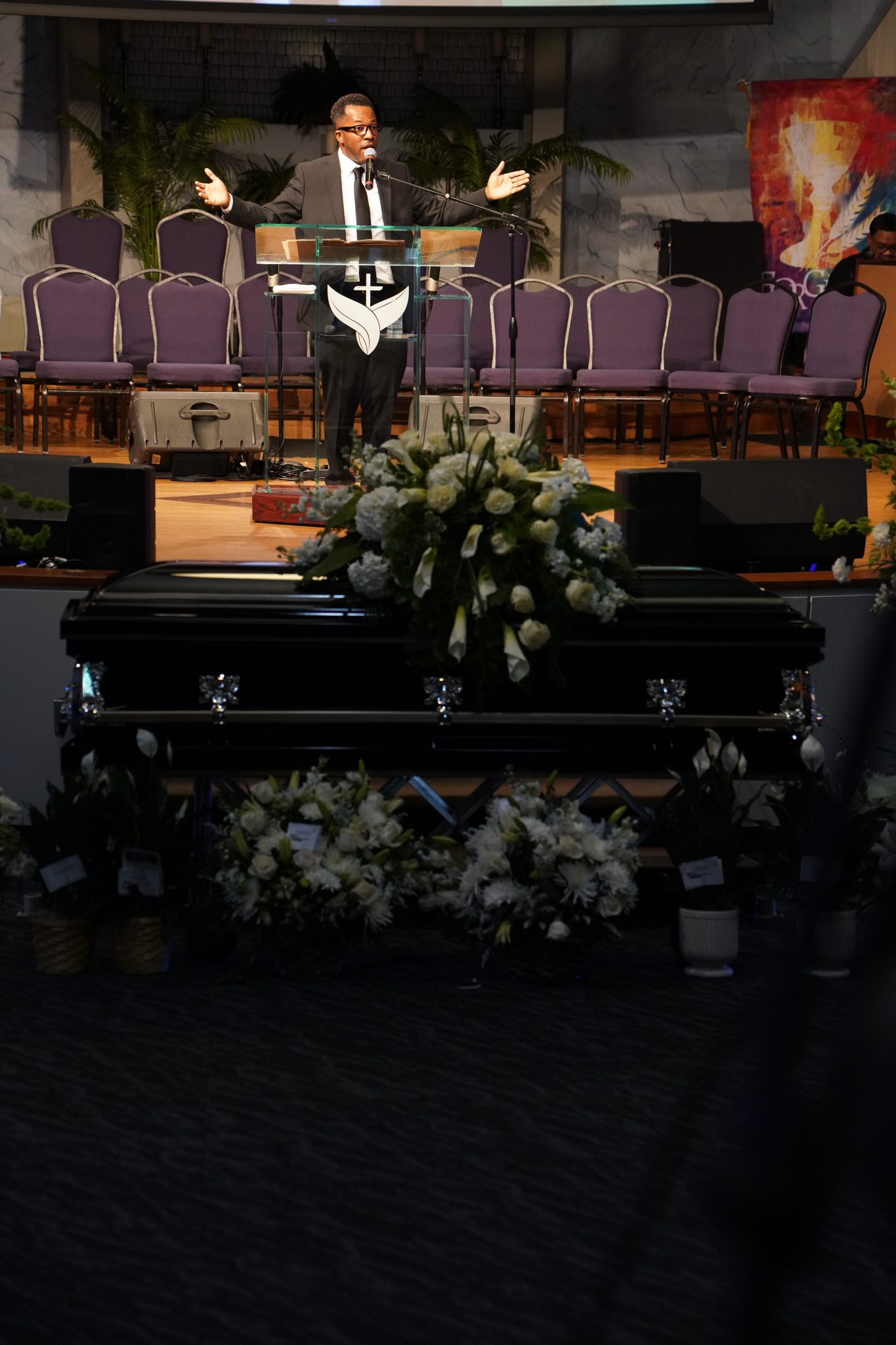
Editor’s Note: Nationally acclaimed journalist, author and public intellectual Bankole Thompson delivered the following eulogy on Aug. 25, 2026, at Empowerment Church in Southfield, Michigan, during the funeral of Dr. William G. Anderson, the legendary civil rights leader, physician and former president of the Albany Movement in Georgia, who worked alongside the Rev. Dr. Martin Luther King Jr. in the struggle against Jim Crow. Anderson, who died at 98, was a founding faculty member of the Michigan State University College of Osteopathic Medicine and became the first African American president of the American Osteopathic Association.
Titled “William G. Anderson And The Empty Chair At The Constitutional Convention Of 1787,” Thompson’s address departed from the conventions of a traditional funeral tribute. Rather than simply recount Anderson’s biography, Thompson placed the civil rights pioneer within the larger constitutional history of the United States, arguing that Anderson’s generation helped enlarge the meaning of “We the People” for those excluded from the nation’s founding compact. Thompson, 47, a twice-week opinion columnist at The Detroit News, Founder and Chairman of The PuLSE Institute, the Detroit-headquartered national anti-poverty and economic justice think tank, brought a distinctive connection to that history as the first journalist in American history to serve on the National Board of Directors of the Southern Christian Leadership Conference, the organization founded by King and other civil rights leaders.
The address was also deeply personal. Anderson had followed Thompson’s work for years and personally invited him in 2020 to deliver the keynote address for the 20th Annual Dr. William G. Anderson Slavery to Freedom Lecture Series at Michigan State University, a distinguished and historic moral platform whose previous keynote speakers included civil rights titans Congressman John Lewis and Harry Belafonte. Following Anderson’s funeral, his family and several mourners thanked Thompson for what they described as a masterful tribute. The eulogy is published below as delivered.

I’m Bankole Thompson. I stand here not only as a journalist, author but also a friend of Dr. William G. Anderson. I also stand before you as a former National Board Member of the Southern Christian Leadership Conference, Dr. King’s organization which worked together with Dr. Anderson’s Albany movement.
To the presiding minister of Empowerment Church, Rev. Dr. Carlyle Fielding Stewart; to the children of Dr. Anderson Gil Anderson, Laurita Faison, Vale Jeanita Henson, Frank Lewis Anderson and Darnita Dawn Hill to the entire Anderson family; clergy; distinguished guests; and friends: I am deeply grateful to the Anderson family for the privilege of standing before you today to offer these brief reflections on the life of a remarkable man.
And I have been thinking about a room. A room in Philadelphia in the summer of 1787.
Inside that room sat George Washington, Benjamin Franklin, James Madison and other delegates to the Constitutional Convention, wrestling with the architecture of a new republic.
They were asking questions that would travel across centuries: What is liberty? Who possesses power? What are the obligations of government?
And ultimately: Who belongs in “We the People”? They produced one of the most consequential political documents in human history. But there was something morally incomplete about that room.
Too many chairs were empty. There was no chair for the enslaved. No chair for the Black people. No chair for women. No chair for Native Americans. No chair for the millions whose labor and suffering were already helping build the nation those men were attempting to define.
And there was no chair for a man like William G. Anderson. Dr. Anderson was born more than a century later. But I submit to you this morning that he belonged in that room. He deserved a chair. Because his life possessed precisely the moral imagination that America’s founding room lacked.
The founders debated representation. Anderson’s life asked: Who is missing?
They debated power. Anderson’s life asked: What is power for?
They constructed a republic. Anderson’s generation demanded that the republic finally recognize the humanity of those it had excluded. That is why William G. Anderson belongs not simply to the history of civil rights. He belongs to the constitutional history of the United States. Because the Constitution was not completed morally in Philadelphia.
Its meaning has been contested and enlarged ever since. It was contested by the abolitionists. It was contested at Seneca Falls. It was contested during Reconstruction. It was contested in Montgomery. It was contested on the Edmund Pettus Bridge.
And it was contested in Albany, Georgia. There, a young physician named William G. Anderson confronted the defining moral crisis of his time. He could have chosen comfort. He chose conscience.
He could have healed bodies and remained silent about the sickness of segregation. Instead, he understood that sometimes the physician must also diagnose the society.
And the diagnosis was unmistakable: America was suffering from a profound contradiction between its creed and its conduct.
A nation that proclaimed liberty practiced segregation. A nation that celebrated equality constructed a racial caste system. A nation that called itself democratic forced Black citizens to struggle for rights supposedly guaranteed by its Constitution.
Anderson’s generation did not reject the American promise because of those contradictions. Their moral achievement was far more demanding.
They insisted that America become what America said it was. That was the genius of the Civil Rights Movement.
It held the nation accountable to its own vocabulary.
You said liberty. Then let us see liberty.
You said equality. Then let us experience equality.
You said “We the People.” Then answer the question: Who exactly is the “we”? William Anderson spent his life enlarging that word.
I had the privilege of knowing him, and one of the extraordinary things about Dr. Anderson was that history seemed almost ordinary around him. Rosa Parks was his patient. Think about the moral poetry of that. The woman whose refusal to surrender her seat on a Montgomery bus became one of the defining acts of American democracy was cared for by a physician who had himself helped lead another defining campaign for freedom. Rosa Parks fought over a seat on a bus. William Anderson fought over who deserved a seat in America.
Perhaps the struggle for democracy has always been, in one form or another, a struggle over the chair.
Who gets to sit? Who must stand? Who enters the room? Who remains outside? Who gets heard? Who gets ignored? Who gets counted? And who is told to wait? That is the moral question behind the empty chair.
Dr. Anderson once told me that he was a big fan of my work. I thought it was a funny joke. Here was a man who had worked with Martin Luther King Jr., confronted Jim Crow and lived among some of the most consequential figures of the American freedom struggle telling me that he followed my work.
But he was serious. Then, in 2020, he called me personally. He said he wanted me to keynote the 20th Annual Dr. William G. Anderson Slavery to Freedom Lecture Series at Michigan State University. I was surprised. And humbled. Because I knew the history of that platform. John Lewis had spoken there. Harry Belafonte had spoken there. These were not simply famous Americans. They were moral witnesses to their age.
For William Anderson to ask me to enter that conversation remains one of the great honors of my public life. But with time, I have come to understand that the most important thing about that telephone call was not the invitation. It was the assignment. Elders like Anderson do not merely give us stories. They give us responsibilities.
They ask: What will you do with what we suffered to give you?
That question becomes especially urgent now. America is 250 years old. We will celebrate the Declaration of Independence. We will invoke Jefferson. We will honor Washington, Franklin and Madison. And we should.
But a nation becomes morally mature only when it is capable of celebrating its founding without concealing its contradictions. At 250, perhaps America should ask not simply: Who founded America?
But: Who made America more faithful to its founding? Who forced liberty to mean more than it originally meant? Who enlarged “We the People”? Who demanded that America include those whom the original republic left outside the room?
Frederick Douglass did.
Harriet Tubman did.
Ida B. Wells did.
Rev. Jesse Louis Jackson Sr. did
Rosa Parks did.
Martin Luther King Jr. did.
John Lewis did.
Fannie Lou Hamer did.
My mentor Rev. Bernard LaFayette Jr.
And William G. Anderson did.
These men and women were not footnotes to the American founding. In a profound sense, they continued it. Because every generation must decide whether “We the People” is a closed sentence or an expanding moral proposition.
I think about my 17-year-old son, Jelani Bankole Thompson, and his generation. They were born into freedoms for which they never had to march. That is both a blessing and a danger. Because freedom inherited without memory can eventually be mistaken for freedom that was inevitable. Nothing about freedom was inevitable.
Somebody marched. Somebody went to jail. Somebody was beaten. Somebody lost a job. Somebody stood before power and refused to move. Somebody paid the bill before we arrived at the table. We owe a debt to William Anderson’s generation.
But gratitude is not enough. The only adequate repayment for inherited freedom is responsible humanity. Every generation must pull up another chair. Dr. Anderson used to say: “If you can’t leave the world better than you found it, then we don’t need you.”
That is an entire philosophy of humanity. It asks us to measure life differently. Not simply: What did you acquire? What title did you hold? How close did you get to power? Not how much power you’ve accumulated and done nothing for your people as the Head Negro in Charge.
But: What became more just because you were here? Who became more free because you acted? Whose dignity did you defend? What injustice did you disturb? What door did you open? What chair did you pull up?
William Anderson had an answer. And now he is gone. When an elder like William Anderson dies, it is as though a museum has disappeared. The documents remain. The photos remain. The archives remain. But the living witness is gone.


John Wesley once declared: “I look upon all the world as my parish.”
For William Anderson, Albany was his parish. It was there that conscience called him into history. But his parish did not end in Georgia. Detroit became part of his parish. Michigan became part of his parish. Medicine became part of his parish. Education became part of his parish.
And perhaps, in the final accounting, America itself was William Anderson’s parish. Because he understood that there is no geography beyond the reach of moral responsibility.
So I return one final time to Philadelphia. To that room.
To 1787.
To the empty chair. And this time I imagine William G. Anderson sitting there. A Black physician from Albany. One generation removed from slavery. A man who confronted Jim Crow. A man who walked with King. A man who cared for Rosa Parks. A man who healed bodies while helping heal a wounded democracy.
And perhaps Dr. Anderson would look around that room at the founders and say: You created a remarkable republic. You gave us a consequential Constitution. You announced revolutionary ideals.
But your moral imagination was not large enough for your own words. Your room was too small. Your “we” was too narrow. Your liberty excluded too many. And then perhaps he would tell them what his 98 years demonstrated: America becomes greater every time it makes the room larger.
Every time it widens the circle. Every time it recognizes somebody it once refused to see. Every time it pulls up another chair. William G. Anderson spent his life making the American room larger. He left Albany better. He left Detroit better. He left medicine better. He left America better.
And to Gil, Laurita, Vale Jeanita, Frank Lewis and Darnita Dawn, your father did something few of us will ever be able to say: He helped leave a nation better than he found it. That is your family’s inheritance.
But it is also America’s inheritance.
Rest well, Dr. Anderson. Rest well, my friend, I will miss that booming voice on my voicemail in the mornings, I will miss our conversations, I will miss all the stories you had to share. You earned your chair. You’ve rightfully walked the long walk to freedom in the tradition of Nelson Mandela, you have spoken truth to power in the tradition of Frederick Douglass.
And now the chair belongs to us. May we have the moral courage not to leave it empty.