


By Tina M. Patterson, Esq
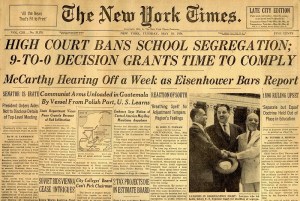
May 17, 1954. Brown v Board of Education.
A landmark legal case, marking the end of the Jim Crow era and ushering in new wave of rights for a previously disenfranchised population. A watershed moment that led to the historic Civil Rights Movement just one year later. A seminal moment in the nation’s history.
The history of educational suppression against African Americans, which included outlawing teaching African Americans to even read in many states, is what made the Brown case so significant. It analyzed the damaging psychological effect of lesser than treatment against African Americans and admitted the faulty conclusion of the previous Plessy v Ferguson legal standard of “separate but equal,” which Brown famously overturned.
The case is also famous for the legendary litigation prowess of Thurgood Marshall, the extraordinary Black litigator, who rightfully earned an appointment to nation’s highest court as first Black Supreme Court Justice. Many other towering Black legal luminaries were involved, including Charles Hamilton Houston and Constance Baker Motley, who later served as the first Black woman appointed to the federal judiciary.
Brown certainly has a rightfully rich history and rich legacy. But as all riches, it is of no use if we do not draw wisdom from its wealth, and if it is not preserved in proper context for the following generations to build upon or benefit from.
70 years and multiple generations later, we are still seeing the effects of improper or unwilling implementation of this law. Racial disparity and segregation in education remains prevalent, with 200 such school desegregation cases pending, half of which are from the NAACP Legal Defense Fund, the organization that successfully won the Brown case 70 years ago.
Michigan recently had a taste of educational disparity with the right to literacy case, which The PuLSE Institute filed an amicus brief in support of the right to literacy for Black schoolchildren in Detroit, who despite compulsory education by State of Michigan, were regularly subject to classrooms with no books, supplies, working utilities, or even teachers. In 2020, the U.S. Sixth Circuit Court of Appeals ruled in favor of the children, a historic decision that provided the right to education sufficient to provide access to a foundational level of literacy.
Since that time, just four years ago, the overwhelming need for equality in education has only increased in urgency, particularly with the advance of technology, including the new omnipresence of screens and the rapidly evolving tool of artificial intelligence. This is especially true in the aftermath of the Covid-19 pandemic, which saw virtual learning skyrocket, along with constant and prolonged interruptions throughout the school years, while reading and math scores significantly decreased.
While Brown may not have anticipated such technological advances and its effect on education, the core of the ruling remains relevant to ensure that all are provided the equal opportunity for social progression through education.
A rather unique attribute of Brown is also its collection of Brilliant Black minds, top notch legal thinkers and researchers, united around a common cause for the betterment of humanity. This fact, coupled with the central argument of the case, demonstrates that the best investment still is and always will be in human intelligence, of which education plays a central role from the earliest, most formative years.
Brown also stands the test of time as a reminder that challenges, no matter how big, must be faced head on, even when the popular standard is against you. As perfectly and eloquently stated by Dr. Martin Luther King, Jr., in his book, Where Do We Go From Here:
“In any social revolution there are times when the tail winds of triumph and fulfillment favor us, and other times when strong head winds of disappointment and setbacks beat against us relentlessly. We must not permit adverse winds to overwhelm us as we journey across life’s mighty Atlantic; we must be sustained by our engines of courage in spite of the winds. This refusal to be stopped, this “courage to be,” this determination to go on “in spite of” is the hallmark of any great movement.”
Brown is a quintessential reminder to face the storms of adversity we will face in life. Yet while it is critical to be aware of and reflect on our past, it is not sufficient to just do so to check the box. Such reflection is necessary for one purpose- to continue to grow and advance the future. History is foundational, but it cannot be enough just “to know,” what happened. To recite the facts, as if memorizing answers to a test, is an insufficient insult. It is also not enough to mark the occasion or anniversary with a celebratory post or nominal event.
This applies to the Brown case. It is not simply a legal case to cite or a historical event to memorize. It is a living, breathing, application of the law that strikes right at the nation’s mantra of liberty and justice for all.
Attorney Tina M. Patterson is the President and Director of Research at The PuLSE Institute, the national anti-poverty think tank headquartered in Detroit. For submission inquiries email info@thepulseinstitute.org
