

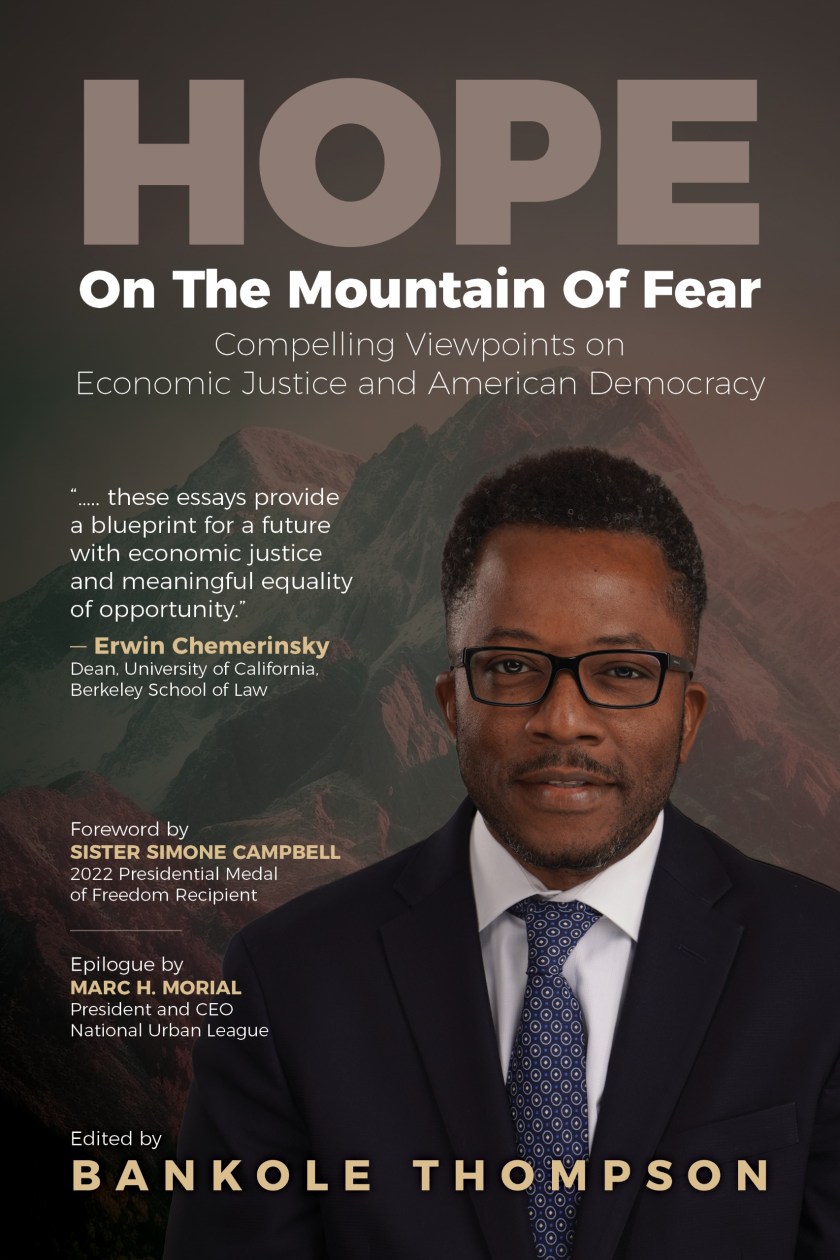
Journalistic thought leader and voice of liberation Bankole Thompson has long occupied a distinctive space in American public discourse where journalism meets moral inquiry and where reporting becomes a form of civic engagement. Known for centering issues of economic justice, inequality, and democratic accountability, Thompson has built a body of work that consistently elevates underserved communities while interrogating how power, policy, and wealth shape everyday life in America.
Through his reporting, commentary, and multimedia platforms, Thompson has consistently challenged systems of concentrated power while elevating the lived experiences of communities too often left out of economic and political decision-making. His work is rooted in a simple but urgent conviction: democracy cannot function without economic inclusion, and justice cannot be separated from opportunity.
Over the years, he has emerged as a leading advocate for rethinking how power operates in American life—particularly how wealth, policy, and institutional access shape who gets to participate fully in society. An interpreter of power, his voice is often associated with a tradition of truth-telling journalism that confronts inequality not as an abstract issue, but as a daily reality in housing, affordable care, employment, small business development, and community survival.
Rather than treating inequality as a distant policy debate, Thompson approaches it as a lived condition—visible in housing instability, unaffordable care, strained public institutions, the shrinking economic mobility of working families, the state of the news media, racial justice. His work challenges readers to confront not only what is happening in society, but why it is happening, and how to address the crisis.
His latest book, Hope: On The Mountain Of Fear, is a collection of essays that arrives at a moment of heightened national uncertainty. The book explores urgent and topical issues at the intersection of economic justice, inequality, hope, and democracy, offering a sustained reflection on how societies respond when opportunity becomes unevenly distributed and trust in institutions begins to erode.
What makes Hope: On The Mountain Of Fear resonate with the legacy of Rev. Der. Martin Luther King Jr. is not simply its themes, but its moral posture. It speaks with urgency, grounded in reality but oriented toward transformation. It refuses to separate justice from democracy or hope from action. The book echoes the enduring message of King not by imitation, but by continuing the moral argument King left unfinished. That at the heart of that connection is a shared conviction: democracy is hollow without inclusion and addressing the glaring disparities that are so evident in American life.
King’s vision of hope was never naive. It was rooted in struggle, sacrifice, and persistence and what he called “the fierce urgency of now.” Thompson echoes this directly in his framing of hope in the book.
Across its essays, the book is not defined by despair. Instead, it positions hope as an active force: not optimism detached from reality, but the disciplined work of confronting injustice while still insisting on the possibility of repair and renewal.
The urgency of Hope: On The Mountain Of Fear lies in its timing. The book enters public conversation amid widening inequality, rising costs of living, state of the media, and ongoing debates about who benefits from economic growth. Thompson’s essays challenge readers to reconsider assumptions that inequality is inevitable, instead presenting it as a result of policy choices, institutional design, and political will.
Rather than offering simple solutions, the book invites reflection on structural change—how investment priorities, and public policy frameworks can either expand or restrict opportunity. It also asks readers to reconsider the meaning of hope itself in a period marked by uncertainty: not as passive endurance, but as engagement, responsibility, and collective action.
For readers, policymakers, community leaders, and anyone concerned with the future of democracy and inequality, preordering the book online before its official release is more than an early purchase—it is an act of engagement with a growing national conversation. It signals support for a body of work that seeks to bridge moral language and structural analysis, and to re-center economic justice within discussions of democratic renewal.
Thompson’s book enters this moment as both diagnosis and challenge. It asks readers to reconsider assumptions that inequality is inevitable and instead frames it as a policy and moral choice—one that can be changed through deliberate action, investment, and democratic accountability. It also reframes hope itself: not as sentiment, but as collective agency—the belief that systems built by people can be reshaped by people.
Why People Should Preorder the Book
Preordering also allows readers to be among the first to engage with a collection that is designed not only to be read, but to be discussed, debated, and brought into civic spaces—from classrooms and community forums to policy discussions and public dialogue.
Through this work, Bankole Thompson continues his role as a voice of liberation—one committed to illuminating uncomfortable truths while insisting that change remains possible.
