

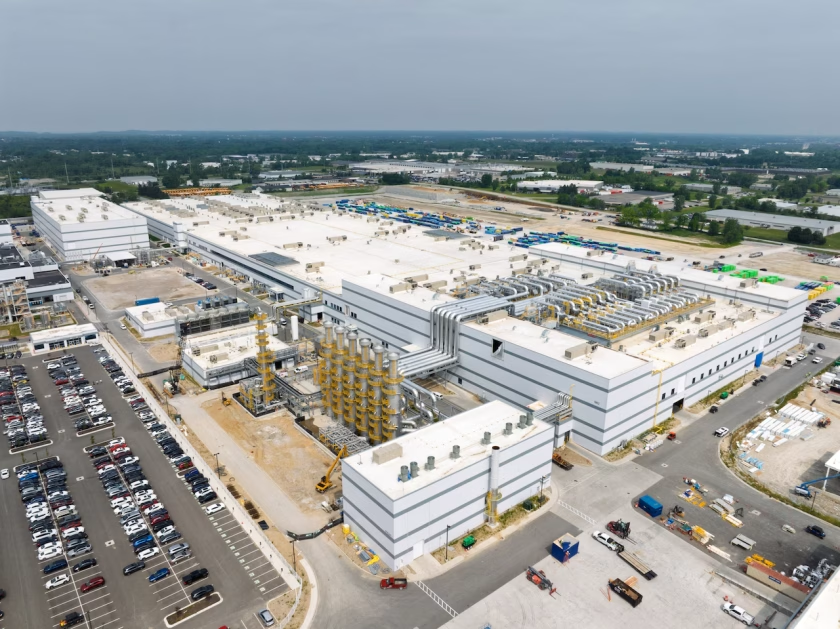
PuLSE Institute Annual Virtual Economic Justice Conference Brings Together DTE Energy Executive Chairman Jerry Norcia, President and CEO Joi Harris and Other Business Leaders to Confront Economic Justice, Corporate Stewardship and Who Benefits from the Data Center Boom
As the world prepares to observe the United Nations International Day for the Eradication of Poverty on October 17, The PuLSE Institute will convene its Annual Virtual Economic Justice Conference on Monday, October 12, from 8:30 a.m. to 12 noon, placing one of the most consequential economic developments of the modern era, the extraordinary expansion of data centers within a larger moral examination of poverty, prosperity and the responsibilities of leadership.
The conference is deliberately being held during the week of the United Nations observance to acknowledge the International Day for the Eradication of Poverty and to underscore The PuLSE Institute’s founding mission as an independent anti-poverty think tank: ensuring that poverty and the conditions confronting economically marginalized communities remain central to the decisions of institutions with the power to shape economic life.
The 2026 conference will be held under the theme: The Moral Responsibility of Leadership in the Data Center Age: Economic Justice, Corporate Stewardship, and the Future of American Prosperity.

Among the confirmed speakers are Jerry Norcia, Executive Chairman of DTE Energy, and Joi Harris, President and CEO of DTE Energy, who will join other major leaders for a searching examination of the economic, energy and societal consequences of America’s rapidly expanding data-center infrastructure.
The conference’s principal plenary session will be: Data Centers and Economic Justice: Who Benefits from the Digital Economy?
As artificial intelligence, cloud computing and other emerging technologies accelerate demand for massive digital infrastructure, billions of dollars are being invested in data centers across America. Communities are confronting enormous new demands for energy and infrastructure alongside promises of jobs, investment, tax revenue and economic development.
But The PuLSE Institute will place a different question at the center of the conversation: Who benefits?
The conference will examine whether communities hosting data centers are positioned to participate meaningfully in the prosperity those investments generate and whether the extraordinary resources being committed to powering the digital economy can also become instruments for expanding economic opportunity and confronting persistent inequality.
Discussions will address workforce development, local hiring, minority business participation, community investment, energy demand, sustainability, infrastructure, public incentives, corporate accountability and the long-term relationship between data-center developers and the communities in which they operate.

At the heart of the conference is an even larger moral inquiry: In a world still confronting poverty, what responsibilities accompany the extraordinary concentration of capital, technology and economic power required to build the infrastructure of the future?
Bankole Thompson, Founder and Chairman of The PuLSE Institute, said linking the conference to the United Nations International Day for the Eradication of Poverty is both deliberate and essential to the Institute’s mission.
“The eradication of poverty cannot exist on one sideline of the public conversation while billions of dollars in new economic investment exist on the other. They must be brought into the same room. If we can summon extraordinary capital, technology and human ingenuity to build the infrastructure that will power artificial intelligence, we should possess the imagination and moral will to ask how this new prosperity can expand opportunity for people who have been left behind,” Thompson said.
Thompson, a nationally acclaimed journalist, author and public intellectual, whose work has long focused on poverty, democracy, economic justice and corporate responsibility, said the data-center revolution presents a profound test of contemporary leadership.
“The data center age is not merely testing the capacity of our electrical grid or the ingenuity of American enterprise. It is testing our conscience. Innovation can transform an economy, but leadership determines whom that transformation serves. The moral question is whether this extraordinary new economy will enlarge the circle of opportunity or create another frontier of prosperity that millions can see but never enter.”
The United Nations designated October 17 as the International Day for the Eradication of Poverty to promote awareness of the need to eradicate poverty and destitution throughout the world. For The PuLSE Institute, observing the day through a conference examining the emerging digital economy reflects The Institute’s conviction that the struggle against poverty must evolve alongside the forces reshaping economic life.
The participation of DTE Energy’s top leadership will bring the perspective of the energy sector directly into that inquiry. The expansion of data centers cannot be separated from questions surrounding energy generation, grid capacity, infrastructure investment, affordability and the economic consequences of meeting unprecedented electricity demand.

Attorney Tina M. Patterson, President and General Counsel of The PuLSE Institute, said the United Nations observance provides an important context for examining the meaning of economic development.
“The International Day for the Eradication of Poverty asks the world to remember people whose economic circumstances too often render them invisible in conversations about growth and progress. Our conference brings that imperative directly into the data-center debate,” Patterson said. “Economic justice requires communities to be more than locations on a development map. They must be stakeholders in their own economic futures.”
Patterson said corporate stewardship becomes especially consequential when private investment and public resources converge around projects capable of reshaping communities for generations.
“Corporate responsibility is most meaningful when it extends beyond the walls of the corporation. Jobs, infrastructure, public resources, sustainability and long-term community benefit cannot be secondary questions,” Patterson said. “Responsible development should create value for companies while also strengthening the communities that make development possible.”
The conference will bring together perspectives from technology, energy, business, economic development, public policy and community leadership to examine questions that will increasingly define the data-center era.
Among them: What constitutes genuine community economic benefit from a data center? What should communities expect in exchange for public incentives? Who bears the costs associated with infrastructure expansion? What employment and contracting opportunities will be available to local residents and businesses? How can small and minority-owned businesses participate in the emerging supply chain? How should sustainability, land, energy and other resource considerations be addressed? And what obligations should corporations assume toward communities whose resources help power the digital economy?
For an Institute founded around the urgency of poverty, these questions cannot be divorced from the circumstances of Americans struggling at the economic margins.
The PuLSE Institute is an independent anti-poverty and economic justice think tank dedicated to confronting poverty and advancing economic justice through research, public policy, civic engagement and high-level leadership forums. Its work has consistently sought to bring the realities of economically marginalized communities into conversations with those who exercise significant institutional and economic power.
The Institute’s high-profile Speaker Forum has attracted captains of industry and CEOs, university presidents, policy analysts, advocates, public officials and international figures. Previous speakers have included former United Nations Under-Secretary-General and UNFPA Executive Director Dr. Natalia Kanem, Federal Bankruptcy Judge Mark Randon, former U.S. Ambassador Anne Derse, Huntington National Bank Chairman Gary Torgow, Cindy Pasky, Founder and CEO of Strategic Staffing Solutions, Blue Cross Blue Shield of Michigan President and CEO Tricia Keith, leading African American minister and civil rights activist Rev. Dr. Frederick Douglass Haynes III and Minnesota Attorney General Keith Ellison, among other distinguished leaders.
Additional business, technology, policy and community leaders participating in the October 12 conference will be announced in the coming days.
The timing of this year’s conference, just days before the October 17 United Nations observance, is intended to make a larger statement about the relationship between technological progress and human progress.
“We should not wait twenty years to discover whether the data-center revolution strengthened communities or merely passed through them,” Thompson said. “We should ask the difficult questions now, while billions are being invested, infrastructure is being constructed and the rules of the new economy are still being written. On a week when the world is called to confront poverty, we should also ask whether the enormous wealth and ingenuity powering the future can help create a future in which fewer people are poor. That is the moral responsibility of leadership,” Thompson added.
The conference ultimately rests on a proposition that reaches beyond technology and data centers: A society capable of building the infrastructure of the future must also possess the moral courage to confront the poverty of the present.
Whether America’s data-center expansion becomes an instrument of broadly shared prosperity or another chapter of economic growth disconnected from those most in need of opportunity will depend on the choices leaders make today.
