


Thirteen years after my first one-on-one conversation with one of Detroit’s most consequential business leaders, the city has proved that capital can transform a skyline. The moral test is whether prosperity can transform the lives beneath.
By Bankole Thompson
Thirteen years ago, I invited Dan Gilbert, today one of America’s wealthiest businessmen, with a fortune Forbes now estimates at $22.9 billion, to sit down with me and talk about Detroit.
He accepted.
It was 2013, and I had invited Gilbert to appear with me at the Good Governance Summit at Wayne State University Law School. Our one-on-one conversation became one of the highlights of the gathering.
A year later in 2014, the invitation went in the other direction.
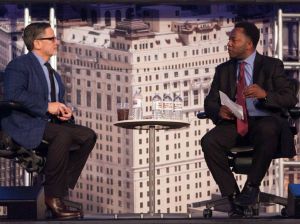
Gilbert invited me to join him for a public conversation at the Crain’s Detroit Homecoming conference about the recovery and future of the city.
I accepted.
That invitation placed me inside another remarkable encounter. At the same gathering, I introduced Gilbert and Warren Buffett onstage for their conversation about investment in Detroit. Buffett and I spent time together in the green room. Our conversation turned to economic inequality, the widening distance between extraordinary wealth and the economic insecurity experienced by millions of Americans.
I have never forgotten the juxtaposition. Outside the green room were two of America’s most consequential businessmen preparing to discuss
investment in a city attempting one of the most dramatic economic recoveries in modern urban America.
Inside the room, Buffett and I were talking about inequality. In retrospect, those were not two different conversations. They were the same conversation. Because investment and inequality ultimately meet at the same moral intersection: What does economic growth mean for people who possess little economic power?
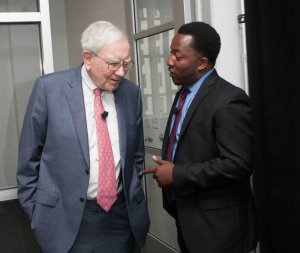
Then, in 2017, I went to Gilbert’s office. He gave me a tour, and we sat down to discuss an issue that had increasingly occupied my journalism: Inclusive growth.
I recount these encounters not to advertise access. Access, by itself, is meaningless unless it produces insight. But relatively few journalists in Detroit have had repeated opportunities to sit one-on-one with Gilbert as I have on public stages and in private conversation asking questions about Detroit, its recovery and who ultimately participates in its prosperity.
That history has given me a particular vantage point from which to observe both Gilbert and the transformation of this city. And after thirteen years, I keep returning to essentially the same question: What does it mean for a city to become wealthy if large numbers of its people remain poor?
Adam Smith would recognize the question. This year marks 250 years since the publication of Smith’s An Inquiry into the Nature and Causes of the Wealth of Nations, one of the foundational texts of modern economic thought.
Smith is routinely invoked in boardrooms and economics classrooms as the great philosopher of markets and self-interest. But Smith was a moral philosopher before he became the patron saint that some modern defenders of capitalism have made him. His economic thought cannot be completely separated from his concern with justice, sympathy and the human consequences of economic arrangements.
That matters in Detroit because an economy is not an abstraction. It is a human arrangement. And the moral significance of prosperity ultimately rests upon what that prosperity makes possible in human lives.
When Gilbert accepted my invitation in 2013, Detroit was approaching one of the most consequential chapters in its modern history. The city was confronting fiscal collapse and would soon enter the largest municipal bankruptcy in American history because, capital had fled, confidence had collapsed and neighborhoods had endured decades of disinvestment.
Gilbert was making an enormous bet in the opposite direction. He was acquiring downtown properties and placing enormous private capital behind a proposition many people outside Detroit regarded skeptically: Detroit could come back.
He deserves recognition for that because serious analysis cannot pretend the transformation of downtown did not occur or that private investment played no role in it.
Let’s face it. Buildings once associated with abandonment became occupied, businesses arrived and construction cranes returned.
Hudson’s Detroit now rises from ground that for years represented both the memory of Detroit’s commercial grandeur and the emptiness left by its disappearance.
Detroit proved something important and that is capital could believe in Detroit again. But that was never the final test because the wealth of a city cannot be measured only by the value of its buildings. It must ultimately be measured by the condition of its people.
I was reminded of that recently in a setting far removed from any corporate boardroom or Gilbert’s office. In August, I stood before mourners at Empowerment Church in Southfield, Michigan, to deliver the eulogy for Dr. William G. Anderson, the 98-year-old civil rights giant who helped lead the Albany Movement in Georgia, where he worked alongside Dr. Martin Luther King Jr.
I titled the eulogy “William G. Anderson and the Empty Chair at the Constitutional Convention of 1787.”
The empty chair represented those who were absent when America’s political architecture was being constructed. That included enslaved Black people, women and Native Americans who had no chairs.
The poor possessed little meaningful chair. People whose lives would be governed by the decisions made in that room were largely absent from the room itself. The Constitution would proclaim a new political order. But millions of human beings would have to struggle for generations simply to obtain a seat within its promise.
That empty chair has stayed with me because America has spent nearly 250 years deciding who gets to sit down. And Detroit has its own empty chairs. They are economic.
There is an empty chair when a child grows up within sight of extraordinary investment but receives an education that leaves opportunity beyond reach.
There is an empty chair when a working parent watches the cost of housing rise in the city faster than a paycheck.
There is an empty chair when an entrepreneur possesses the idea, discipline and determination to build a company but cannot gain access to capital.
There is an empty chair when a longtime resident survives Detroit’s years of abandonment only to discover that the prosperity of the comeback seems to belong principally to somebody else.
There is an empty chair whenever people are invited to celebrate economic growth but not meaningfully participate in it.
That is Detroit’s unfinished question: Who has a chair at the table of prosperity?
The question is not rhetorical. It belongs in corporate boardrooms. It belongs at City Hall. It belongs in Lansing. It belongs inside banks, foundations, universities, hospitals and development companies. And it belongs in journalism.
Because Detroit has undergone an extraordinary physical transformation while deep economic distress persists among many residents.
Both realities are true.
Intellectual seriousness requires us to hold them together because it is possible to celebrate investment and interrogate inequality. It is possible to applaud entrepreneurship and demand inclusion.
It is possible to recognize Gilbert’s extraordinary impact on downtown Detroit while asking whether the architecture of the city’s resurgence is reaching deeply enough into the economic lives of people who endured Detroit when investment was scarce and optimism even scarcer.
That is not hostility toward capitalism. It is a question about capitalism worthy of Adam Smith.
What is wealth for?
Development can transform property, but economic justice transforms possibility. That distinction was at the heart of my 2017 conversation with Gilbert about inclusive growth because inclusion cannot simply mean allowing residents to observe prosperity. It must mean creating credible pathways into it.
It means whether a child born into poverty can obtain an education capable of altering the trajectory of that child’s life. It means whether working people earn enough to live with dignity rather than merely survive. It means whether homeownership remains attainable. It means whether neighborhood entrepreneurs can obtain capital. It means whether longtime residents possess a meaningful stake in the appreciation of the city they sustained through its hardest years. And when public resources help facilitate private development, it means asking whether the public receives a meaningful return.
In other words: Where are the chairs? And who is sitting in them?
Those are questions I would place before every corporate boardroom discussing Detroit’s future. Not as accusations, but as obligations. Because business leaders should want Detroit’s recovery to become deeper. A city with widespread economic security creates homeowners, consumers, entrepreneurs, educated workers and stable neighborhoods.
Poverty is therefore more than a moral wound. It is wasted human capacity. And no serious theory of economic growth should be comfortable with the mass wasting of human capacity.
This is where the conversation becomes larger than Dan Gilbert. No individual businessman created Detroit’s poverty. No individual businessman can eradicate it. The responsibility belongs to government, corporate leadership, philanthropy, universities, banks, health systems, developers and community institutions. And it belongs to those of us entrusted with platforms from which Detroit’s story is told.
Journalism has its obligations, too. We should not measure Detroit’s success merely by counting cranes. Nor should we reduce every act of private investment to exploitation. Both are intellectually inadequate.
The harder work is to ask whether capital and conscience can inhabit the same economic vision. Weather growth can be ambitious and inclusive. Whether private success can coexist with serious public obligation. Whether the prosperity generated in a city’s center can eventually become visible at kitchen tables throughout the city. And whether those without economic power are merely discussed at the table or finally given chairs around it. That is a conversation worthy of Detroit’s corporate boardrooms.
It is 2026. The buildings downtown have answered one question. The investment has answered another. Detroit can attract capital, build extraordinary things and persuade investors to believe again.
But the most morally consequential question remains unanswered: Can Detroit create enough economic chairs for the people who call this city home?
Adam Smith published The Wealth of Nations 250 years ago. Perhaps Detroit should spend this anniversary asking what the title itself means.
What is the wealth of a city? Is it the aggregate value of its real estate? The capitalization of its corporations? The number of billion-dollar developments? Or must the ultimate balance sheet include the human beings whose lives unfold beneath the skyline?
Thirteen years after I first sat across from Dan Gilbert, I don’t question whether capital can transform a city. I have watched it happen.
The question I would now put before Gilbert and before every CEO, developer, philanthropist and public official who exercises economic power in Detroit is more demanding: Can we demonstrate that the transformation of a city can transform the economic destiny of its people?
Dr. William Anderson spent much of his 98 years confronting an America in which too many people had been denied a chair. His generation helped pull chairs toward the table of democracy.
This generation has another obligation. That is to make certain that democracy’s table is not surrounded by people who possess political rights but remain economic spectators. Detroit does not need another decade in which prosperity is something poor families can see but cannot touch.
It does not need people standing outside the windows of a renaissance looking in. It needs chairs for workers, homeowners, entrepreneurs, children whose ZIP codes should never determine the boundaries of their futures and for families who stayed when leaving would have been easier.
That was the moral question underneath my conversation with Dan Gilbert thirteen years ago. It remains Detroit’s unfinished question today. A renaissance cannot be complete while too many of the people who survived the decline are still waiting for a chair at the table of prosperity.
Bankole Thompson is a nationally acclaimed Detroit journalist, author and public intellectual whose work has examined power, economic justice and democracy for more than two decades. He is one of the first Black editors to conduct exclusive sit-down interviews with former President Barack Obama. He is a twice-weekly opinion columnist at The Detroit News and previously served as the longtime editor of the Michigan Chronicle. His influential work on race, poverty and democracy inspired the founding of The PuLSE Institute, an anti-poverty think tank. Thompson’s body of work was entered into the Congressional Record in 2018, and his papers are preserved at the University of Michigan’s Bentley Historical Library. His fifth book, Fiery Conscience was reviewed by Forbes. His forthcoming seventh book, Bankole Thompson’s 12 Moral Questions: Frederick Douglass and the Soul of America at 250, features a foreword by Dr. Lawrence Edward Carter Sr., founding dean of the Martin Luther King Jr. International Chapel at Morehouse College, who describes Thompson as “one of America’s greatest prophetic journalists.”
