

Who Speaks for the Poor When the World’s Most Powerful Leaders Gather in New York this Week?
By Bankole Thompson
This week, the world has come to New York. Presidents, prime ministers, diplomats and delegations representing 193 nations are gathering beneath the great architecture of the United Nations to speak about war and peace, climate and technology, development and human rights. Every nation has a flag. Every government has a delegation. Power has arrived with credentials.
But as I watch the 81st United Nations General Assembly unfold, I am looking for another delegation. It represents no government. It travels with no motorcade. It occupies no diplomatic residence. Its members number in the hundreds of millions, live on every continent and endure decisions made in rooms they will never enter.
I am looking for the delegation of the poor.
Where is their chair? That question should hover over the United Nations this week. The official theme of the 81st session is “Restoring Trust, Managing Transformation: A United Nations That Delivers for All.” It is an ambitious declaration at a moment when trust itself has become one of the world’s most depleted resources.
The UN acknowledges the landscape confronting it and that is brutal conflicts, widening inequality, climate emergencies, declining confidence in institutions and an information environment increasingly polluted by hatred and disinformation. Its agenda reflects the enormity of the moment.
Leaders are confronting war and international security, the Sustainable Development Goals, climate action and a just transition, sea-level rise, pandemic preparedness, racial discrimination and nuclear weapons.
Artificial intelligence and digital governance are also central to the Assembly president’s agenda, carrying profound questions about inequality, bias, surveillance, opportunity and exclusion.
There is even a high-level commemoration of the 40th anniversary of the Declaration on the Right to Development, a landmark declaration asserting that development requires participation, equality and the equitable distribution of economic resources.
That language is important. But language has never been humanity’s principal shortage.
The world has produced declarations about poverty while poor people remain poor. It has convened summits about hunger while children remain hungry. It has adopted development goals while entire populations remain spectators to economic systems that determine whether they eat, receive medical care, attend school or live with dignity. The crisis confronting the United Nations, therefore, is not simply whether nations are represented. It is whether human suffering has standing in the rooms where power decides.
THE EMPTY CHAIR IS NOT ABOUT INVITATIONS
When I delivered the eulogy on Aug. 25 at the funeral service for the 98-year-old civil rights giant and pioneering Black physician and surgeon Dr. William G. Anderson, who led the Albany movement in Georgia and worked with Rev. Dr. Martin Luther King Jr., I invoked what I called the Empty Chair at the Constitutional Convention of 1787.
The chair represented those whose humanity was implicated in the decisions being made but whose voices were excluded from making them.
The enslaved Black person had no chair. Women had no chair. Native Americans had no meaningful chair. Poor people had no chair. Yet decisions made inside that room would govern their lives and the lives of generations after them. The Empty Chair is therefore not merely about physical absence. It is about the distance between being affected by power and possessing power.
That distinction matters enormously at the United Nations and should concern leaders attending the high-level talks in New York.
The institution was created around the sovereignty of nations. Its General Assembly gives member states a voice, while the Security Council reminds us of another reality: international power has never been distributed equally.
But poverty does not carry a passport. Hunger recognizes no national border. Economic insecurity does not ask whether the person experiencing it lives in a democracy, monarchy or authoritarian state.
A mother deciding whether to purchase food or medicine in Detroit is not living the identical experience of a mother confronting extreme deprivation elsewhere in the world. History, political systems and material circumstances matter.
But they share something morally significant. They understand what happens when an economy presents choices no human being should have to make. Their governments may be represented in New York. But are they?
THE MORAL LANGUAGE OF HUMAN DIGNITY
Maya Angelou spent much of her literary life insisting upon the irreducible dignity of people whom history had attempted to diminish. Her work matters to this conversation about the United Nations because poverty is not merely a question of income. It is also about what happens when human beings are rendered peripheral to decisions governing their own existence.
Angelou’s moral universe refused that diminishment. The poor are not economic abstractions. They are not percentages inside development reports. They are not objects of pity waiting for the generosity of those above them. They are human beings possessing memory, aspiration, intelligence, agency and dignity.
Toni Morrison understood another dimension of power and that is who gets seen, who gets named and whose experience becomes central to the story a society tells about itself. Her literary achievement repeatedly moved people relegated to the margins of American history into the center of moral and imaginative life.
That insight belongs in the halls of global governance in New York because invisibility is one of power’s most effective instruments.
A person can be counted without being heard and a community can appear in a report without possessing influence. An entire population can become the subject of policy without becoming an author of policy. The Empty Chair exists wherever people are discussed extensively but heard inadequately.
THE UN’S OWN AGENDA MAKES THE CASE
Consider what leaders themselves have placed before the world this year. One of the six pillars of the Assembly president’s agenda is called “No One Left Behind, No Country Left Out.”
Another is “Innovation with Inclusion,” dealing with artificial intelligence, digital governance, science and technology. Another concerns human rights and protection under the formulation “Freedom from Fear and Want.” And the final pillar invokes the opening words of the UN Charter itself: “We the Peoples, Reimagined.”
Those phrases should not become diplomatic poetry. They should become moral tests.
If artificial intelligence generates extraordinary wealth while eliminating livelihoods, who possesses a chair when the rules governing AI are written? If the transition to cleaner energy creates enormous new markets while poor communities absorb disproportionate costs, who possesses a chair? If developing nations devote scarce public resources to servicing debt while hospitals, schools and basic infrastructure remain underfunded, who possesses a chair? If rising seas threaten small island nations that contributed comparatively little to the emissions driving climate change, who possesses a chair? If another pandemic arrives and wealthy nations again secure lifesaving medicines before poorer countries can obtain them, who possesses a chair?
These are questions about the architecture of power.
MANDELA, KING AND THE MORAL SCANDAL OF POVERTY
Nelson Mandela understood that architecture. After spending 27 years imprisoned by an apartheid system designed to determine whose humanity counted, Mandela emerged not simply arguing for political participation but insisting that freedom could not be separated from the material conditions in which people lived.
Speaking in London in 2005, Mandela described overcoming poverty not as charity but as an act of justice. That should echo through the United Nations this week.
Charity asks what the powerful are willing to give. Justice asks why the powerless were denied their share in the first place.
Rev. Dr. Martin Martin Luther King Jr. understood the same moral emergency as Mandela.
On March 31, 1968, Dr. King climbed into the Canterbury Pulpit at Washington National Cathedral and delivered what would become his final Sunday sermon, Remaining Awake Through a Great Revolution. Four days later, he was assassinated in Memphis.
King used one of the last sermons of his life to cry out about poverty. He reminded an affluent America that roughly 40 million of its people were living in poverty. He had seen them in the urban North, the rural South and Appalachia. Yet he warned that prosperity had made them almost invisible: America’s highways could carry the comfortable past deprivation without requiring them to confront it.
King’s argument can be paraphrased this way: For the poor, there was no convenient exit from poverty simply because the prosperous could take an exit that allowed them not to see it.
That is the moral scandal Dr. King was describing because the poor could not change the channel. They could not leave the neighborhood. They could not take another highway around their own deprivation. There was no exit sign from the economic condition governing their lives. And Dr. King was not delivering an abstract sermon about compassion.
He was preparing with my late mentor and his close associate Rev. Dr. Bernard LaFayette Jr. to return to Washington with the Poor People’s Campaign to demand jobs, income and economic security. He understood that desegregation and voting rights, indispensable as they were, could not constitute full citizenship if millions remained trapped in economic desperation.
That makes Dr. King’s final Sunday sermon astonishingly relevant to this week’s gathering at the United Nations. Nearly six decades later, the geography has changed but the moral question has not.
There are still people whom prosperity allows the prosperous not to see. There are still communities the global economy can pass by. There are still children whose hunger exists beyond the windows of international finance. There are still workers displaced by technological transformation designed in rooms they will never enter. There are still nations struggling beneath debt burdens while wealth moves across borders at extraordinary speed. The world has built faster highways. The poor still cannot find the exit.
Dr. King and Mandela came from different histories and confronted different systems. But both arrived at a profound moral truth: Human dignity cannot be divided into political and economic compartments.
A person cannot eat the right to vote. A constitutional guarantee cannot repair a leaking roof. A declaration of human rights cannot by itself place medicine in the hands of a sick child. Political equality becomes dangerously incomplete when economic arrangements repeatedly deny people the material foundation necessary to exercise meaningful agency.
DEVELOPMENT IS NOT THE SAME AS DIGNITY
Perhaps no event this week better captures the issue than the commemoration of the Declaration on the Right to Development. Forty years ago, the United Nations articulated a principle that remains radical in its implications: human beings should participate meaningfully in development and share equitably in its benefits. That is substantially different from merely measuring economic growth.
A nation can grow richer while millions remain economically insecure. A city can attract billions in investment while neighborhoods remain trapped in poverty. Technology can produce extraordinary productivity while workers become more disposable. Global wealth can expand while human dignity contracts. This is where Angelou, Morrison, Dr. King and Mandela converge despite their profoundly different lives and intellectual traditions because human beings cannot become footnotes to progress. Development that requires people to disappear from the moral calculation is not development worthy of the name.
THE POOR HAVE NO SECURITY COUNCIL
The most powerful nations possess institutions through which their strategic interests are defended. Markets have armies of lobbyists. Corporations have lawyers, government-relations teams, consultants and access to policymakers. Capital rarely arrives at the negotiating table without representation.
The poor frequently arrive as statistics. We count, study, photograph and produce reports about them. We convene conferences in their name. But representation is not the same as being represented. The poor have no Security Council. There is no permanent seat reserved for the child whose future is being determined by sovereign debt.
There is no veto belonging to the refugee. There is no motorcade carrying the woman who walks miles for clean water. There is no diplomatic immunity protecting the worker displaced by an economic transformation designed by people who will never experience its consequences.
This is the Empty Chair. Not invisibility alone but powerlessness.
RESTORING TRUST REQUIRES MORE THAN DIPLOMACY
The United Nations says it wants to restore trust. Then it must understand why trust is disappearing. People lose faith in institutions when institutions speak eloquently about their suffering but appear incapable of altering the conditions producing it. Trust cannot be restored ceremonially. It must be restored materially.
The world’s poor do not need another declaration assuring them that they matter. They need budgets demonstrating that they matter. Trade arrangements demonstrating that they matter. Technology policies demonstrating that they matter. Climate financing demonstrating that they matter. Debt structures demonstrating that they matter. Public-health systems demonstrating that they matter. And governments demonstrating that economic development is not merely something done around people but something in which people possess agency. That is what it would mean for the United Nations to deliver “for all.”
FROM DETROIT TO THE UNITED NATIONS
The scale is different, but the moral architecture is familiar. In my Detroit News column this week examining the proposed public support for the redevelopment of Detroit’s Renaissance Center, I raised a question about the relationship between public resources, private capital and working families.
Government, I argued, cannot be endlessly imaginative for capital and unimaginative about poverty. That principle does not stop at the Detroit River. Whether the room is a corporate boardroom in Detroit, a state capitol, the United States Congress or the General Assembly Hall at the United Nations in New York, the moral question remains: Who is missing when consequential decisions are made?
And perhaps more importantly: Who is present but still powerless?
That is the deeper meaning of the Empty Chair. It does not demand that every person literally occupy every negotiating room. It demands something more serious that is the fact that institutions should build mechanisms through which those most affected by power have meaningful influence over how power is exercised. That is not charity. It is legitimacy.
PULL UP THE CHAIR
By the end of the United Nations gathering, presidents will return home. The motorcades will disappear from Manhattan. Diplomatic receptions will end. Communiqués will be issued. The microphones inside the General Assembly will eventually go silent.
But hunger will not adjourn. Poverty will not issue a communiqué. The refugee will not suddenly acquire a homeland because a speech received applause. The child without clean water will never know which president commanded the room. And somewhere in the world, another family will discover that decisions governing its future were made in rooms it could never enter.
The United Nations begins its Charter with three extraordinary words: “We the peoples.” Not we the governments, markets or the powerful.
Maya Angelou taught us to recognize the dignity power attempts to diminish.
Toni Morrison demonstrated what happens when those pushed to the margins become central to the telling of history.
Nelson Mandela insisted that overcoming poverty belongs to justice rather than charity.
And in one of the final sermons of his life, Rev. Dr. Martin Luther King Jr. stood in the National Cathedral and demanded that an affluent society finally see the poor it had learned to pass by.
They all represent different voices, histories but one moral summons: Human beings must never become spectators to decisions governing their own dignity.
Eighty-one sessions later, the opening words of the UN Charter remain both a promise and an indictment. If the United Nations truly intends to restore trust, manage transformation and deliver for all, it should begin by looking around the rooms where the world’s future is negotiated.
Look beyond the flags, the diplomatic credentials, the motorcades and prepared speeches. It must look for the person whose life will be transformed by decisions made there but whose voice cannot reach the table. It should find the Empty Chair and pull it up to the table of equity.
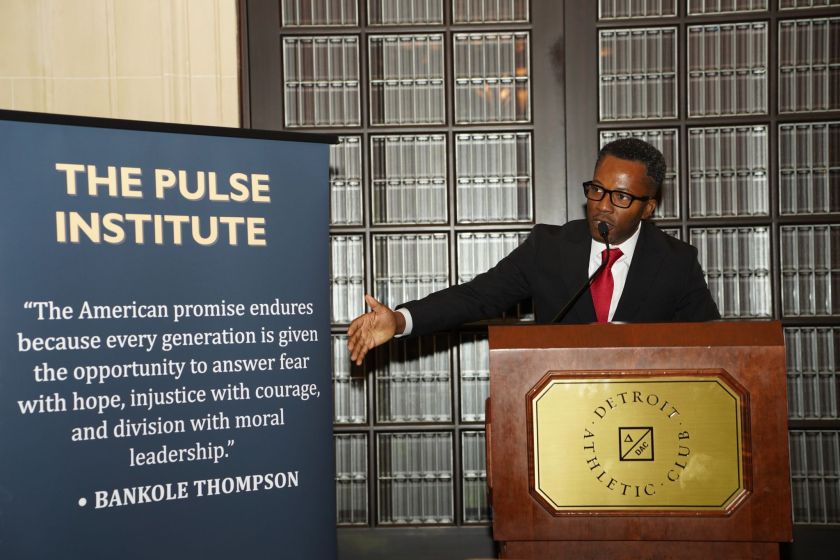
Bankole Thompson is a nationally acclaimed journalist, author, public intellectual and sought-after keynote speaker whose work examines power, poverty, democracy and the moral responsibilities of leadership. A twice-weekly opinion columnist at The Detroit News and founder and chairman of The PuLSE Institute, an independent anti-poverty and economic justice think tank, Thompson became the first journalist in American history to serve on the National Board of Directors of the Southern Christian Leadership Conference, the historic civil rights organization co-founded by Rev. Dr. Martin Luther King Jr.
The author of six books, Thompson is known for bringing history, moral inquiry and contemporary public policy into conversation. His papers are preserved at the University of Michigan’s Bentley Historical Library. His forthcoming seventh book, Bankole Thompson’s 12 Moral Questions: Frederick Douglass and the Soul of America at 250, examines the American conscience at the nation’s 250th anniversary. Through keynotes, lectures and public conversations, Thompson challenges audiences to confront a defining question of our time: What does power owe those who possess the least of it? He can be reached at bankole@bankolethompson.com
