

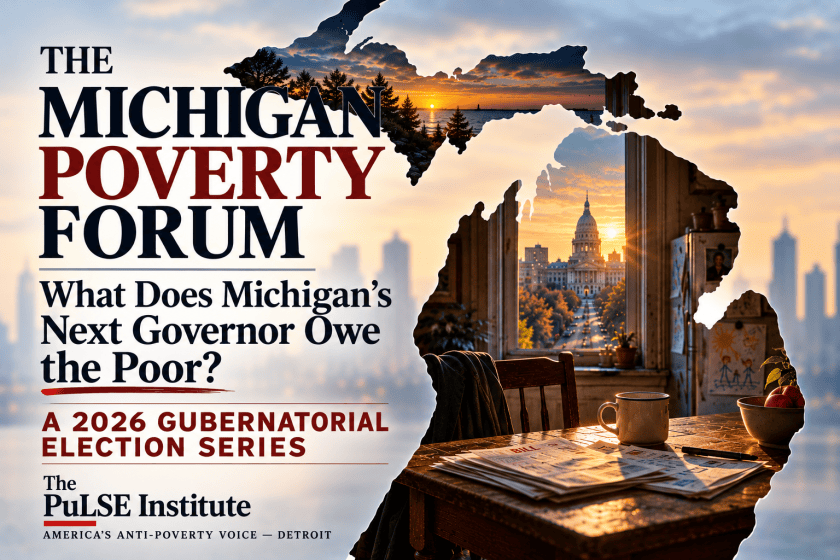
The PuLSE Institute launches the Michigan Poverty Forum with a fundamental question: What does Michigan’s next governor owe the poor?
By Bankole Thompson
Founder & Chairman, The PuLSE Institute
Editor-in-Chief, PuLSE Ideas & Commentary
Conscience is meaningless if it never disturbs our comfort.
It is easy to speak about poverty as a statistic, a government program or a campaign talking point. It is harder to confront poverty as a moral question and one that demands something not only from government, but from business, philanthropy, education, labor and every institution that exercises power.
Four days before his assassination, the Rev. Martin Luther King Jr. entered the pulpit of the Washington National Cathedral for what would become his final Sunday sermon.
King spoke about a nation of extraordinary wealth still confronted by profound deprivation. He reminded his listeners of something that remains unsettling nearly six decades later: “We are caught in an inescapable network of mutuality.”
His point was larger than charity. Human beings cannot finally separate their own well-being from the conditions in which their neighbors are forced to live.
King was preparing at the time for the Poor People’s Campaign, an effort intended to bring poor Americans of different races and backgrounds directly to the seat of national power and force poverty onto the conscience of the country.
Among those King entrusted with that unfinished work was Rev. Dr. Bernard LaFayette Jr., the legendary civil rights giant and architect of the 1965 Voting Rights Act who took on responsibility of the 1968 Poor People’s Campaign. LaFayette, who died earlier this year, would decades later become my mentor, a relationship that made King’s unfinished struggle against poverty more than history to me.
Michigan should bring that question to the seat of power again.
On Nov. 3, voters will choose Michigan’s next governor. The major-party nominees Democratic Secretary of State Jocelyn Benson and Republican Congressman John James are competing to succeed term-limited Gov. Gretchen Whitmer.
Between now and Election Day, Benson and James will offer competing visions for Michigan. They will debate jobs, taxes, education, affordability, economic development and the future direction of the state.
But beneath those subjects sits a question that should be impossible for either candidate or anyone seeking the authority to govern to escape: What does Michigan’s next governor owe the poor?
Not what should be said about them. What should be done?
That question is the foundation of The Michigan Poverty Forum, a new initiative of PuLSE Ideas & Commentary, the editorial platform of The PuLSE Institute, the national and independent anti-poverty and economic justice think tank based in Detroit.
The Forum grows directly out of PuLSE’s mission: to place poverty, economic inequality and the responsibilities of leadership before those who possess the power to do something about them.
Over the coming weeks, we will commission original essays from consequential and diverse voices across Michigan including leaders from business, labor, education, philanthropy and community life; economists and scholars; and people for whom economic insecurity is not an academic subject but a lived reality.
They will not be asked to agree. They will be asked to think.
What does Michigan misunderstand about poverty?
Why can someone work every day and still struggle to afford housing, transportation, food and childcare?
What responsibilities belong to government and what responsibilities belong to employers, universities, philanthropy and other powerful institutions?
What should Michigan’s next governor do differently?
And four years from now, by what measures should the people of Michigan determine whether the condition of poor and working families actually improved?
The Forum will also invite Benson and James to address poverty directly under the same editorial conditions and confront the central question themselves: What specifically would their administrations do to materially reduce poverty in Michigan?
But The Michigan Poverty Forum is larger than an election.
Elections come and go. Poverty remains. That is precisely why conscience matters.
A state can celebrate new investment, expanding industries, technological innovation and gleaming development. Those achievements have meaning. But they cannot, by themselves, answer the mother choosing between groceries and an electric bill, the worker whose wages cannot keep pace with rent, or the child whose ZIP code continues to narrow the possibilities of his or her future.
The moral test of prosperity is not simply whether wealth is being created. It is whether human beings are being left behind while we celebrate it.
Nearly six decades after King carried the cause of poor people into the Canterbury pulpit of the Washington National Cathedral, Michigan should be willing to confront the question again.
Prosperity for whom?
The answer should help define what leadership requires next.
