

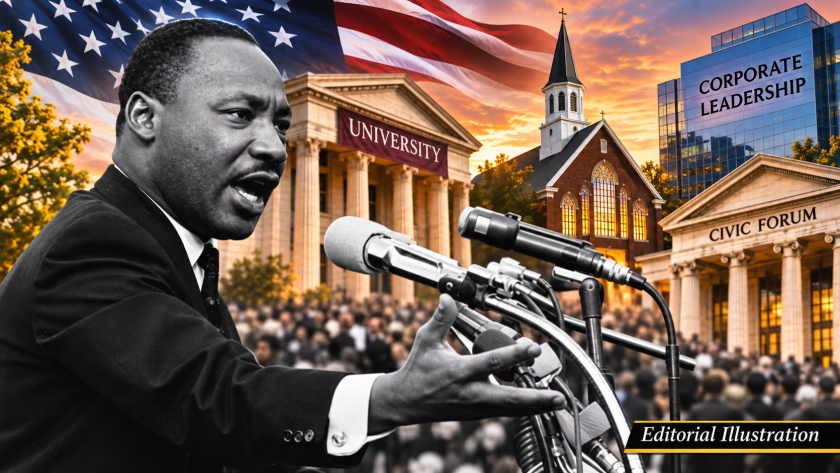
As the nation prepares for the 2027 Martin Luther King Jr. commemoration, America’s most powerful institutions face an unfinished moral examination.
By Bankole Thompson
Nationally Acclaimed Journalist, Author and Public Intellectual
History has a peculiar way of exposing the moral contradictions of a nation. Sometimes the very society that once resisted the architects of its transformation becomes the most enthusiastic custodian of their memory.
But honoring those who changed history is not the same as accepting the obligations they left behind.
I was reminded of this distinction in May 2023, when my late mentor, Dr. Bernard LaFayette Jr., one of Martin Luther King Jr.’s closest lieutenants, invited me to spend several days with him in Selma, Alabama.
The historic city was preparing to honor a man whose courage helped change the course of American democracy.
Sixty years earlier, LaFayette had entered Selma to organize a voting rights campaign amid entrenched segregation, intimidation and the threat of violence. His pioneering work in 1963 helped lay the foundation for the movement that eventually brought King to Selma and contributed to the passage of the Voting Rights Act of 1965.
Now the city was preparing to celebrate him. Yet the significance of those days extended beyond the recognition he was receiving. LaFayette understood the difference between preserving history and fulfilling its demands.
Throughout our relationship, he impressed upon me a conviction central to my understanding of King’s legacy: America becomes a better nation when it practices what King preached.
Not merely when it quotes him, when institutions attach his name to buildings and when the powerful celebrate his dream while leaving undisturbed the economic conditions he devoted his final years to challenging.
A nation can honor the architects of its moral progress while continuing to resist the demands that made their courage necessary.
That contradiction should challenge America’s conscience as the nation prepares for the 2027 commemoration of King’s life and legacy. Every January, university presidents deliver solemn addresses. Corporate executives invoke the dream. Churches summon the language of reconciliation. Political leaders celebrate King’s moral courage.
Auditoriums fill. Awards are presented. Applause follows. Then the ceremonies end. And the economic arrangements King challenged remain largely undisturbed. King has become easier to commemorate than to follow his instructions.
The King America prefers to remember
America has largely confined King to the magnificent oratory of the 1963 March on Washington. But the King of his final years was asking unsettling questions about economic power, the dignity of labor, the obligations of government and the moral legitimacy of extraordinary wealth alongside persistent poverty.
He understood that dismantling legal segregation was indispensable but insufficient. A person could possess the right to enter a restaurant and still lack the income to purchase a meal. A citizen could exercise the franchise while remaining economically powerless.
Political rights without economic opportunity left democracy dangerously incomplete. That conviction helped produce the Poor People’s Campaign, which King announced in 1967 through the Southern Christian Leadership Conference (SCLC).
The campaign was not an appeal for sentimental charity. It demanded jobs, economic security and a fundamental reconsideration of America’s obligations to its poorest people. King challenged the nation to examine not merely who could enter its institutions, but whether those institutions honored human dignity.
His assassination in Memphis interrupted that mission. It did not extinguish its moral demands.
The unfinished economic covenant
America remains the world’s largest economy, yet millions of its people experience poverty, housing insecurity and limited economic mobility.
A democracy cannot measure its achievements solely by the wealth it produces. It must also examine the human conditions under which that wealth is created and distributed.
Economic opportunity becomes an empty promise when families cannot afford housing, educational ambition is constrained by poverty and employment fails to provide meaningful security. These are not simply questions of public expenditure. They concern the moral architecture of American democracy.
King understood that poverty was not merely an unfortunate personal circumstance. It was a public responsibility requiring institutions to examine how opportunity, resources and power were distributed. That understanding should pierce the conscience of every institution preparing to invoke his name.
Higher education’s moral examination
Nowhere is this challenge more consequential than in American higher education. Universities shape public policy, educate future leaders, conduct transformative research and claim a special responsibility for advancing the common good.
Yet their fidelity to King’s legacy cannot be measured solely by the eloquence of their annual commemorations.
It must also be measured by whom they serve. The moral authority of higher education rests not merely in its capacity to produce knowledge, but in its willingness to confront the inequalities that deny millions the opportunity to benefit from that knowledge.
Affordability, educational access, economic mobility and the treatment of campus workers are not peripheral considerations. They are central to the democratic purpose of education.
Community colleges deserve particular recognition as indispensable institutions of economic opportunity, especially for working families and first-generation students.
A university’s greatest tribute to King is not the distinguished speaker it invites in January, but the opportunities it creates for those historically excluded from prosperity.
Corporate America’s unfinished responsibility
Corporate America faces an equally demanding examination. King’s final journey to Memphis placed him alongside striking sanitation workers demanding dignity, fair treatment and recognition of their humanity. That history carries extraordinary relevance in an era of artificial intelligence, automation and technological transformation.
Innovation can expand human possibility. But technological advancement that increases productivity while abandoning workers to economic insecurity raises questions King would immediately recognize.
The distribution of opportunity, protection of workers and preparation of communities for economic transformation are fundamental responsibilities of leadership.
Corporations cannot claim fidelity to King’s economic justice vision through sponsorships, commemorative statements or charitable contributions alone. Their commitments must be visible in employment practices, workforce development and meaningful economic inclusion.
The moral test of corporate leadership is not simply how much wealth an institution generates, but how responsibly it exercises the power that wealth confers.
The church and the Beloved Community
Religious institutions cannot escape this examination. King’s moral imagination emerged from a tradition that refused to separate spiritual conviction from social responsibility.
The Beloved Community was never simply an invitation to personal kindness. It envisioned a social order in which reconciliation, justice and human dignity were inseparable.
Churches that commemorate King must examine whether their ministries confront poverty as a structural injustice or merely respond to its most visible consequences.
Charity relieves suffering. Justice asks why suffering persists. Both matter. But one cannot permanently substitute for the other.
Beyond remembrance
My service on the National Board of Directors of the Southern Christian Leadership Conference reinforced a conviction that LaFayette’s mentorship had already impressed upon me. The civil rights movement was never intended to become a museum of heroic personalities. It was a moral challenge to America, demanding that the nation measure its institutions against the principles it professed.
That challenge now belongs to another generation. Young people deserve more than an inheritance of eloquent speeches and commemorative monuments. They deserve an economy in which opportunity is meaningful, education is accessible, work is dignified and poverty is not treated as an inevitable condition of humanity.
As 2027 approaches, America’s institutional leaders should resist another season of ceremonial admiration without meaningful accountability.
History will not measure our fidelity to King’s legacy by the grandeur of our commemorations. It will measure us by whether we confronted the injustices he insisted were incompatible with a decent society.
The question confronting us in 2027 is not whether America still remembers King. It is whether America finally possesses the moral courage to take him seriously.
Bankole Thompson is a nationally acclaimed journalist, author and public intellectual, widely regarded as Detroit’s columnist of conscience. He is the founder of The PuLSE Institute, the national and independent anti-poverty and economic justice think tank. A twice-a-week opinion columnist at The Detroit News, he is one of the first Black editors in the nation to conduct exclusive sit-down interviews with former President Barack Obama. He made history as the first journalist in American history to serve on the National Board of Directors of the Southern Christian Leadership Conference, co-founded by Dr. Martin Luther King Jr. His most recent books include his fifth, Fiery Conscience, and his sixth and latest, HOPE: On The Mountain Of Fear. Thompson has addressed universities, corporate leaders, civil rights organizations and faith-based institutions on economic justice, democracy and the moral responsibilities of power. He can be reached at bankole@bankolethompson.com
