

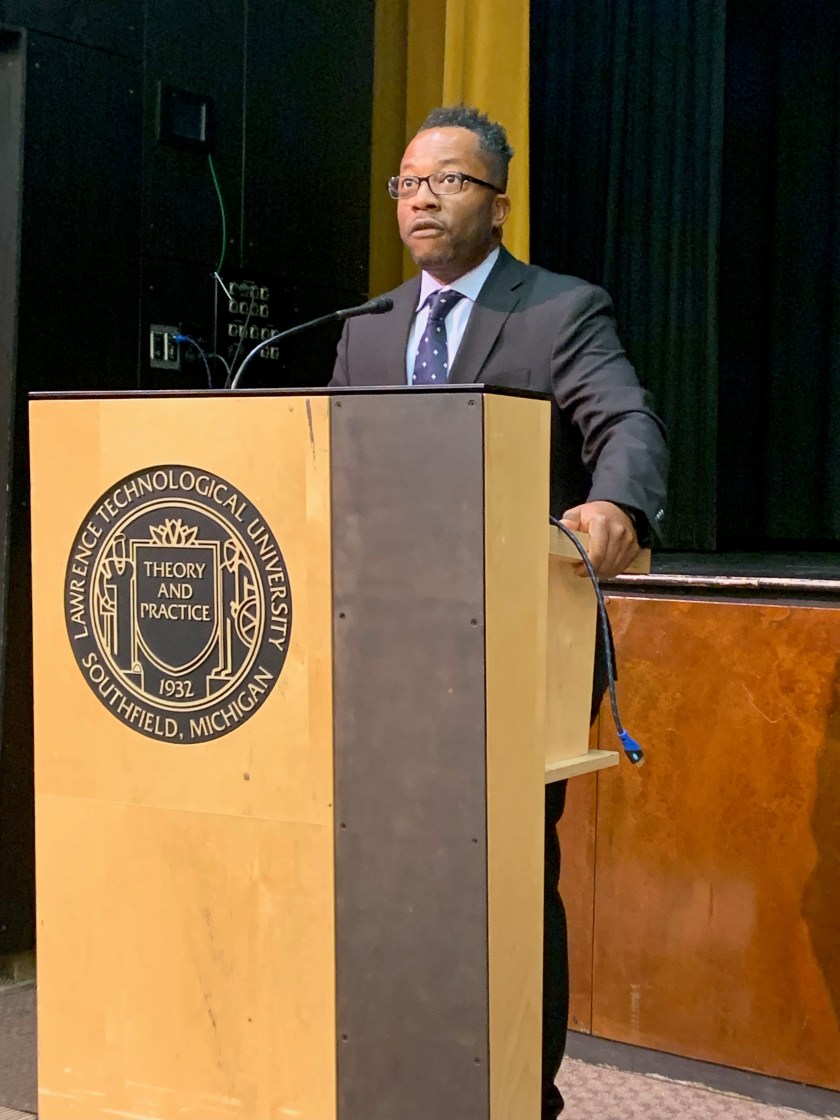
Bankole Thompson, the nationally acclaimed Detroit journalist, author and racial justice champion in a riveting speech given at Lawrence Technological University in Southfield, Michigan on Thursday, Feb. 29, to roundup the tech school’s observance of Black History Month, powerfully defended racial diversity and inclusion initiatives in colleges and universities around the country that have come under attack recently.
Thompson, who is the founding dean of The PuLSE Institute, and a twice-a-week opinion columnist at The Detroit News, was speaking on the theme: “Equitable and Inclusive Higher Education: A Racial Justice Imperative for America’s Future,” for the university’s inaugural Inclusion and Social Change Lecture. The program was sponsored by LTU Office of Diversity and Inclusion in collaboration with the College of Business and Information Technology, College of Architecture and Design, College of Arts and Sciences, College of Engineering, and College of Health Sciences.
“Diversity is a fact and it is strength, not weakness. It leads to academic excellence, not the opposite. Academic excellence and racial inclusion are not mutually exclusive,” Thompson said in his keynote lecture. “They are mutually inclusive, no matter what the merchants of propaganda would want to have some of us believe.”
He said some academic institutions are not embracing racial justice initiatives and that is having an impact on colleges and universities to attract a diverse student body.
“To put simply, we have a racial justice problem in many of our colleges. And the reluctance to address this problem has simply strangulated any effort to guarantee equity and inclusion in higher education,” Thompson said. “It has led to serious and effective DEI initiatives to be viewed as simply a charitable gesture or an afterthought. It has excluded DEI programs from receiving cabinet-level attention in the presidential directives of university administrations. It has made it difficult to attract remarkably talented Black students and other students of color with promise because the student recruitment strategy of some universities that operates under the guise of a merit-based system is actually not based on fostering inclusion or achieving equity at all.”
He noted, “It is therefore imperative that universities like LTU develop clearly defined and equitable policies that will lead to a fair representation of all students from a diverse pool that includes populations that are written off- populations that are sometimes consciously or subconsciously ignored in the outreach strategies of colleges scouting for students.”
As he waxed on the theme of the lecture, Thompson, called on colleges including LTU to make diversity a cornerstone of their academic goals to educate a student body that reflects the growing multiracial demographic in the nation.
“The title (of the lecture) implies that an institution like LTU has an opportunity in this age to be a lantern on the path to a redemptive and equitable education that guarantees access for students coming from vulnerable communities as well as those hailing from severely disadvantaged and underrepresented demographics,” Thompson said. “The title implies that we indeed have a crisis and that universities have become the epicenter of today’s battle for equity in redeeming the soul of the nation. And in this battle that is playing out across the country, only academic institutions with a bold, courageous and futuristic vision with true racial diversity and inclusivity as the pillars of their engagement in fostering a rich and diverse academic environment, will indeed become a blueprint for the future of our rapidly growing multiracial nation.”
Thompson, a public intellectual and standard-bearer for economic justice issues, was named last year to the highest decision-making body- the national board of directors- of the historic Atlanta-based Southern Christian Leadership Conference (SCLC), the signature civil rights group of the Civil Rights Movement founded by Rev. Dr. Martin Luther King Jr., who served as its first president.
His latest book, Fiery Conscience, about his decades of speaking truth to power was released last August to wide acclaim.
Ron Fournier, who served as White House correspondent, and Washington bureau chief for the Associated Press, during which he covered three presidential administrations including Bill Clinton, George W. Bush and Barack Obama before returning to Detroit, praised Fiery Conscience as a “timely tome,” while calling Thompson, “the soul of Detroit” who is “prodding his readers to heed the fierce urgency of now.”
Sister Simone Campbell, a leading anti-poverty and racial justice champion in the modern American Catholic Church who received the 2022 Presidential Medal of Freedom, has followed Thompson’s work over the years.
“In the midst of these turbulent times in our nation, we need Fiery Conscience more than ever. We are all called to speak out for the sake of truth and struggle together across divides to realize a justice that includes all. Bankole Thompson does just that and his witness can nourish our spirits,” Campbell wrote in her endorsement of the book.
Thompson argued during his presentation at the technology college hat we are still an unequal society and that the quest for economic justice remains an inescapable issue.
“I submit to you that it has never been an equal playing field. That has been the hallmark of the long-running Black experience,” Thompson told LTU students and faculty. “Despite the fact that life in itself is a race, not all of us started at the same line. If the playing field was equal there would have been no need for the Civil Rights Movement. There would have been no need for the different efforts around inclusion that have sought to push us into the greater palace of democracy.”
The highlight of his remarks centered on STEM education and ensuring that Blacks and other students of color are adequately represented in a field that is defining the modern technological age. He cited a 2021 study from the Pew Research Center which underscored the underrepresentation of Blacks and Hispanics in the areas of science, technology, engineering and math.
According to the study, “Hispanic workers make up 17% of total employment across all occupations, but just 8% of all STEM workers. Black workers comprise 11% of all employed adults, compared with 9% of those in STEM occupations.”
The report stated that, “The long-term outlook for diversity in the STEM workforce is closely tied to representation in the STEM educational system, particularly across the nation’s colleges and universities.”
“To put it plainly, the Pew study revealed the unequal access to STEM job opportunities. This report is an imperative for LTU to ensure that access to the rich education it offers is extended to all students. LTU has an opportunity to bridge the STEM divide that is so glaring and speaks to the history of the structural inequities that have always informed the nation’s founding,” Thompson said. “ Making STEM education an equal opportunity for all students is the next frontier in the battle for racial and economic justice. And I can’t think of no other institution of higher learning in this region to serve as a reliable ally in this righteous fight for equality than Lawrence Technological University, equipped with the kind of research and faculty to ensure that there is significant student representation in the STEM programs it offers in the range of academic disciplines that make up the core of this institution.”
Thompson remarked: “The modern university must be an incubator that fosters a sense of belonging not separation. The ivory tower university must develop a new model of learning – one that is a community-based education, and that would train future leaders who can deal with the enormous challenges of inequality in the outside world.”
Reflecting on a theme he spoke on when he gave the keynote address two years ago for Brown University’s Black History Month Forum on Race and Democracy, Thompson said the nation’s colleges as institutions of higher learning cannot take a back seat to the issues of equity and diversity shaping the debate around public policy.
“My friends institutions have always played a crucial role in advancing the cause of humanity and in helping men and women reach aspirations to build a greater society where power is not concentrated among those a few but that those at the bottom of the economic scale- confined to a perennial underclass are given an opportunity to compete. Our institutions are called to play an even greater role in the modern er where we have seen a determined, constant, and consistent attack on the very idea of equity and fairness, a cardinal principle of the natural law of justice, during this period of our national crisis,” Thompson posited in the LTU speech. “Educational institutions have an even more sacred and inescapable obligation to serve as an instrument of equality and justice, an uninterrupted marketplace of ideas, a reservoir of knowledge, a fountain of discoveries that would lead to incredible human advancement and growth, and subsequently ensuring that the students who walk into Lawrence Technological University, and other institutions of higher learning, can study in an environment that enables them to make use of their skills and talents and find a sense of achievement.”
Highlighting the urgency of the moment, he said, “This is the time for all institutions to not only serve as the nation’s conscience, but to be a barometer and a vanguard for democracy, where inclusion and equity can flourish and be harvested for the greater good of our society without the hiccups of racial animus and the political rancor that is designed to undermine the gains that have been achieved in the last 50 years.”
Matt Cole, the interim dean of the College of Business and Information Technology applauded Thompson’s remarks as well as Caryn Reed-Hendon, the director of Diversity, Equity and Inclusion at LTU, who introduced Thompson to speak.
Donald Reimer, one of LTU’s longest serving faculty members who began teaching at the university in the 1970s attended Thompson’s lecture and said, “Thanks for sharing your powerful and thought-provoking remarks this evening. It was deeply appreciated. Great message with an amazing delivery. I enjoyed the opportunity to listen and learn from your insightful message.”
