

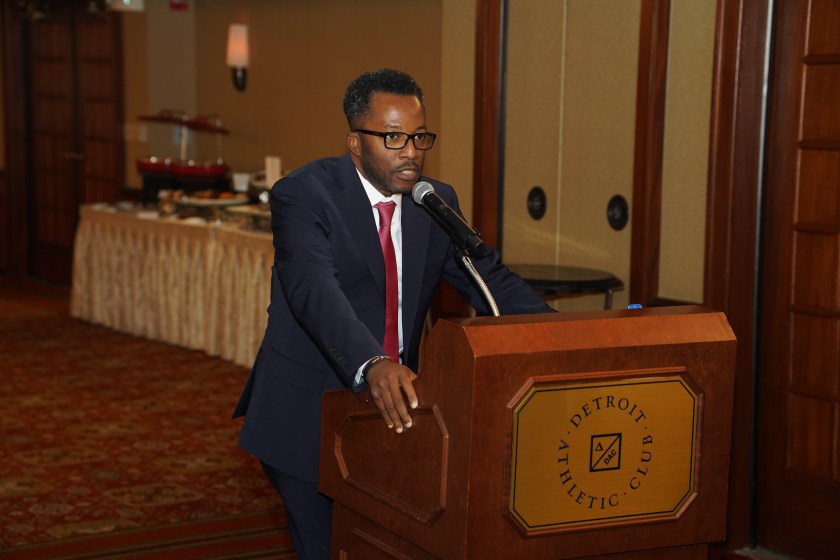
Black college presidents, provosts, deans and vice presidents as well as other administrators in higher education have an obligation to not only demonstrate excellence, but also serve as courageous vanguards of racial justice in an era when the Black community is facing so many socioeconomic and political challenges. They cannot be bystanders or spectators to the crisis of economic inequality facing Black America and they should be champions of economic justice, who are ready to use their positions of power and influence to help those who are drowning in the pool of social subjugation.
That was the message Bankole Thompson, the nationally acclaimed journalist, cultural critic and standard-bearer for economic justice issues brought towards the conclusion of a fellowship meeting of the Thomas A. Lakin Institute for Mentored Leadership, a national organization focused on developing the next generation of African American CEOs in community colleges. The Institute’s work is sponsored by the Presidents’ Round Table of African – American CEOs of Community Colleges. The Institute provides a personal and professional development experience for selected individuals who have demonstrated a potential for expanded leadership roles in their current or future responsibilities within community colleges.

Thompson delivered an address on bold and courageous leadership before two dozen members of the Presidents’ Roundtable of African American CEOs that is made up Black presidents of community colleges from around the country as well as current fellows of The Institute that consists of provosts, deans and vice presidents of community colleges during their Oct. 8 dinner meeting at the Detroit Athletic Club in downtown Detroit.
The week-long meeting in Detroit is hosted by Wayne County Community College District Chancellor Dr. Curtis L. Ivery, whose transformational leadership as a renowned educator and scholar on urban issues is seen as a model for executive educational leadership for African Americans in higher education.
“A decade from now when we look back at this era, the question would be asked of you in this room, what did you do with your positions of influence? Did you stand up on the knowledge of history and the sacrifices that were made on your behalf to speak truth to power from your powerful seats? Or did you look the other way? It is not enough to demonstrate Black excellence from the mahogany offices that you occupy, it is important for you to connect with the struggles of racial and economic justice that our communities are reckoning with,” Thompson said while invoking the legacies of Rev. Dr. Martin Luther King Jr., Nelson Mandela, James Baldwin, Constance Baker Motley, Shirley Chisholm and other Black luminaries and civil rights leaders who shaped the 20th century.
In his remarks, he specifically cited the work of the 97-year-old civil rights activist Dr. William G. Anderson, the former president of the Albany Movement in Georgia, who worked with Dr. King, and later became the first African American president of the American Osteopathic Association. Anderson was a founding faculty member of the Michigan State University College of Osteopathic Medicine which named the Annual Dr. William G. Anderson Slavery to Freedom Lecture Series after him, a series that has featured almost every icon of the Civil Rights Movement including the late Congressman John Lewis and Harry Belafonte. Anderson, in 2020, invited Thompson to deliver the keynote address for the 20th anniversary of the lecture series.
Thompson, whose work on race, democracy and poverty inspired the founding of the anti-poverty think tank, The PuLSE Institute, has always maintained that the great divide of this generation is the ability to speak truth to power. He urged the African American leaders in higher education not to be afraid to make the hard choices in advancing the cause of racial equality.
“Sometimes we have Black leaders who lead or sit on boards of influential organizations and institutions and simply want to go along to get along when they get on those elevated seats. They are always afraid to speak up for the needs of their communities or tell the truth. Instead of standing up for what is right, they are looking to belong to a clique,” Thompson said. “Your role is to be a conscience in the boardroom and at the highest levels of college leadership so you can help bend the arc of the moral universe towards justice by using your institutions as instruments of meaningful change and liberation and by guaranteeing a transformational education to every student who walks into your campus.”
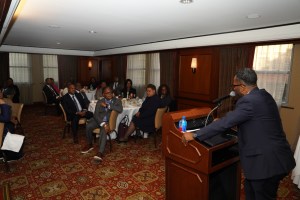
Thompson added, “In order to serve the Black community, you have to love Black people. Often there are Black executives who are quick to disconnect themselves from the historical lineage of Black excellence that produced them. They want nothing to do with the history and impact of the Civil Rights Movement. They think they made it on their own regardless of the battles that were fought in the past to guarantee the freedoms and access that they now enjoy. Frankly, we have to decolonize our minds.”
Thompson, a journalistic thought leader, twice-a-week opinion columnist at The Detroit News, and host of the podcast, Bankole’s Nation, is one of the first top Black editors in the nation to conduct series of exclusive sit-down interviews with former President Barack Obama. He wrote a pair of books on Obama and has appeared on CNN and other national outlets discussing issues affecting urban America.
A sought after leadership speaker and public intellectual, Thompson, writes and speaks with the force of history about public leadership, corporate social responsibility, equity and the political economy. Over the years, he has keynoted and addressed many diverse and leading institutions in the nation.
For example, Thompson keynoted the 2011 Providence Branch of the NAACP 98th Freedom Fund Dinner in Rhode Island in and the 2012 American Jewish Committee (AJC) Detroit Region Annual Distinguished Leadership Dinner. That same year he was the speaker for Henry Ford Health System Martin Luther King Jr. Day Celebration. He was also invited to speak at the 2011 Federal Bench and Bar Conference for the Eastern District of Michigan as well as the 2010 Congressional Black Caucus Annual Legislative Conference among others.
During the height of the Flint lead water crisis, which became an international scandal, the Flint NAACP Chapter invited him in 2017 to deliver the keynote address for the 36th Annual Freedom Fund Dinner under the theme, “Boldness in the Face of Adversity.” His keynote was titled, “Flint: A Paradox of the Declaration of Independence.”
But perhaps among the litany of speeches and leadership presentations Thompson has given in the past, none was more direct in his push for racial equity and bold leadership in higher education than a powerful keynote lecture he gave in 2022 for the Ivy League School Brown University Forum on Race and Democracy, in which he discussed the role of major institutions in advancing racial justice. His keynote which called on Brown and other White institutions to be a reliable ally in the struggle for freedom and justice was described as a tour de force by Brown professor of Africana studies Tricia Rose, the former director of the Center for the Study of Race and Ethnicity in America. Rose moderated a Q&A session with Thompson following his lecture. Brown President Christina Paxson, who delivered the welcome and closing remarks noted the significance of Thompson’s lecture which touched on the many facets of our national life including the death of George Floyd while making the case for economic justice in the modern era.
In his remarks to the Lakin Institute meeting in Detroit, Thompson, paid tribute to Dr. Ivery’s leadership as an exemplary figure of foresight in urban education in the nation.
“Dr. Curtis Ivery is a standard-bearer and a pillar of education in this city and beyond. He is a towering example of Black excellence and for what the consummate Black college president ought to be,” Thompson said.
In closing his speech, Thompson urged the educational administrators to continue to excel in their work and expertise and not to do anything that would allow critics and detractors to find fault or any reason to question the professional integrity of their work in educating the next generation of leaders.
Several of the college presidents and administrators who traveled to the Motor City for the Lakin Institute for Mentored Leadership meeting shared how much they were inspired by Thompson’s powerful remarks, and each received an autographed copy of his latest book, Fiery Conscience, a compendium of analytical essays about his decades of speaking truth to power on the issues shaping the lives of marginalized and disenfranchised communities. The book, Fiery Conscience, released in 2023 and reviewed by Forbes, is his fifth book and it lays out a blueprint for bold and impactful leadership. It is listed in the Jean Blackwell Hutson Research and Reference Division of the Schomburg Center for Research in Black Culture in New York, considered the premier repository on the global Black experience.

“I was inspired by the words of Bankole Thompson as he gave tall charge to education leaders to love the people we are fighting for. We need to remember the shoulders that we stand on because generations before us did more with less resources so have courage during these times,” said Dr. Tonishea Jackson, associate dean of marketing and communications at the University of Chicago’s Crown Family School of Social Work, Policy and Practice. “I left motivated, inspired and invigorated to continue the work of being an education leader in times like this.”
Dr. Van P. Williams, the provost at Palm Beach State College in Florida agreed.
“Mr. Thompson charged us to intentionally engage the community and not to assume that our excellence as educators is enough. His talk further moved me to a personal point of reflection which invoked one of my favorite MLK quotes, ‘Our lives begin to end the day we become silent about things that matter’. Thus, I am more inspired to facilitate student access to teaching and learning ecosystems that fuel generational upward mobility and that will propel students towards economic empowerment for generations yet to be born,” Williams said.

For Dr. Nerita Hughes, the president of Bay College in Escanaba, MI, “Thompson’s insights were spot on.”
“It’s critical that we stay attuned to the political landscape and fully understand its impact – economically, in terms of workforce development and in relation to broader social mobility,” said Hughes, the first African American female president of a community college in the state, who is also a faculty member at the Thomas A. Lakin Institute as well as treasurer of the Presidents’ Round Table. “These factors are deeply interconnected and navigating them thoughtfully is essential to our work.”
On Thompson’s longstanding work, Sister Simone Campbell, leader of the historic “Nuns on the Bus” campaign, and one of the leading anti-poverty champions in the modern American Catholic Church, who has followed Thompson’s work over the years offered this commendation for his book, Fiery Conscience.
“In the midst of these turbulent times in our nation, we need Fiery Conscience more than ever. We are all called to speak out for the sake of truth and struggle together across divides to realize a justice that includes all. Bankole Thompson does just that and his witness can nourish our spirits,” said Campbell, recipient of the 2022 Presidential Medal of Freedom.
