

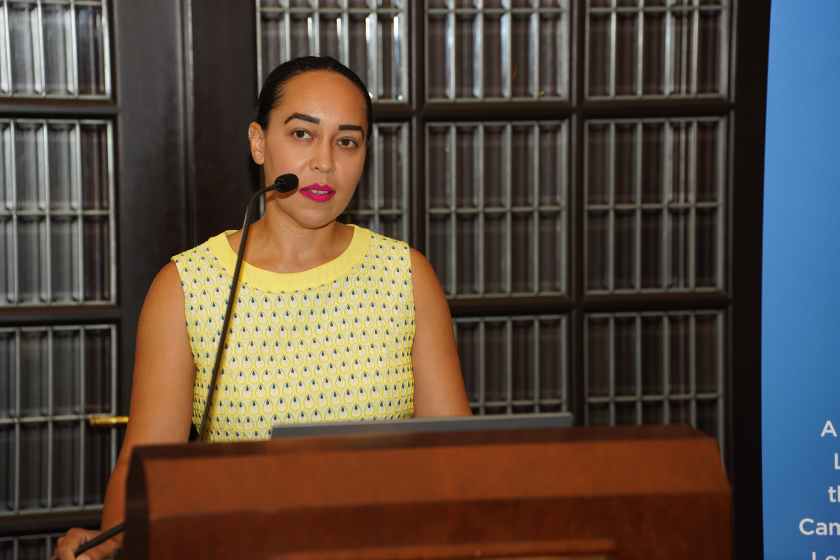
Editor’s Note: Below is the full text of the speech that Attorney Tina M. Patterson, the President and Director of Research of The PuLSE Institute gave at the 2025 Economic Justice Conference hosted and organized by The Institute. The Oct. 14 virtual conference brought together captains of industry, policy makers and advocates to discuss solutions around the issues of poverty and inequality.
Thank you. I am grateful to speak with you all today, and hope this message resounds within the work each of you do. Our previous speakers offered phenomenal perspectives from their head seat in the C-Suites, and I believe as I speak, you will hear resonant themes from the three CEOs of major companies, simplifying the complex and leading with humanity, rather than traditional corporate ideals and regulation.
The world is only as small as we limit it to be. We can look at a map or find a particular country on a globe, but without imagining ourselves being there, we likely will never find ourselves there. However, once we get the idea in our mind and actually go there, our world grows closer and we can then imagine and see ourselves returning as often as we’d like. We’d even begin to imagine ourselves in different locations we haven’t yet gone, but with the confidence from our previous experiences, we become certain that the opportunity is available to us. Opportunity expands as our worldview does.
This idea was presented to me over this past weekend, after a refreshing weekend getaway in the beautiful, mountainous state of West Virginia. While this state is often associated with rural communities and high rates of poverty, it is a gem hidden in plain sight that houses some of the most historic pieces of the nation, offering a unique perspective of possibility and American ingenuity.
While trekking on various hikes in the beautiful state forests, the beauty of the state was presented to me in real time, completely shattering anything I had heard or seen before, and allowing me to appreciate the best of what it has to offer. In fact, it is such a gem, that this was the second time I visited the state this year, which says a lot, since this was the first year I had ever been there in my life.
This relates, back to the imagination, the big idea that the world is only as small as we allow it, as we limit it to be. This especially came to life during a hike to the Mason Dixon line separating the state of West Virginia from the state of Pennsylvania. The infamous Mason Dixon line that was used to separate slave states from free states. It was a grueling trek uphill, northward toward freedom as was the big idea back in the days of slavery in this country over 200 years ago.
At the peak of the line, where the marker stood, at my moment in time, I was able to take it all in and appreciate all the sacrifice and endurance of those who stood before me, which allowed for my world to open up centuries after their world had been legally closed off.
The world is only as small as we limit it to be.
Applying this maxim to our current situation, I interpret this to mean that our problems only grow and persist as long as we allow them. Our opportunities are only self-imposed. And just as easily in turn, our opportunities are only self-expanded.
While this may seem too theoretical or oversimplified, if understood at base level, it is a profound simple truth with the power to shape our destiny.
This brings me to the theme of our conference and the big idea I contribute in our fight against poverty this morning. To truly foster an inclusive and sustainable economy in America, effective leaders must go above and beyond the current state of affairs by embracing and incorporating global diversity as a means of economic justice.
With the shrinking talks of nationalism that dominate our current public policy discussions, effective leaders with courageous foresight must go above and beyond the current state of affairs to bring hope and greater possibility to our economic situation. Talks of limiting expansion of citizenship and hard-line stances on the definitions of an American are not big ideas nor winning ideas in creating economic opportunity. We can see and feel its effects through the increasing rise of the cost of living, the rise of prices of consumer goods, the decrease of the American dollar, and of course most evidently, the current closure of the American government, which is costing millions per day.
Rather than sticking to the traditional status-quo playbook, creative, inspiring and ingenuitive leaders must step outside of the known world and dare to imagine going somewhere, leading their companies and communities to a greater experience that has yet to be explored.
Going above and beyond involves expanding the horizons of our minds to include, rather than exclude, a diversity of thought and experiences into our lives, which increases the value we bring and deliver in the marketplace. A necessary effect of increasing value is increasing economic gains.
As corporate and civic leaders with decision-making authority, we have the power to implement these changes and inject new ideas into our organizations in order to expand opportunities that can in turn alleviate poverty.
I present five key areas required of leaders for effective leadership as we grow an inclusive and sustainable economy in America.
The first is the Firm Acknowledgement that Diversity belongs in the workplace.
Diversity is not a dirty, shameful word that must be scorned upon exiting the mouth when spoken of. Diversity is also not a code word for Black, Hispanic, or other racial and ethnic group historically excluded from greater economic opportunities. Diversity is also not the opposite of excellence.
Rather, diversity is different. And different is distinct in itself. And different is just fine. Combined with excellence, it is an unmatched formula for success.
First, it is a different way of thinking. A way that has not yet been presented. A way that may be better than what has always been done. A way that if implemented, can result in increased productivity and profitability. The true shame in rejecting diversity is leaving uncovered and undiscovered the infinite possibility and profitability that lies in plain sight waiting to be revealed.
Just as if I had deemed West Virginia as nothing more than a rural impoverished state, when it has so much more to offer than what others may judge it for.
Diversity is also a different experience. With the rise of globalization, the world truly does feel as though it is getting smaller, because it is more connected than it has ever been. With this in mind, experience has to be valued and included in the cost of doing business, due to the simple fact of the expansive range of experience there is to cover in the marketplace. Granted, one must define its target market in order to intensify its focus in delivering products and services. However, excluding diversity as a business strategy is a losing deal, which we have seen in major corporations such as Target. Formerly enjoyed a segment of the market that catered to a diverse experience in African Americans, literally rich experience that benefited both company and consumer. However, once diversity was eliminated, so did share in market value.
This leads to the final point on diversity, that discovering, fostering, and valuing hidden and diverse talents benefits the whole. Target is a classic example. And of course, while it is still a successful company, damage has been done to its brand, its authenticity, and its bottom line. Customers and consumers span the range of diversity found in our increasingly global society. And their dollars are powerful indicators of success in the modern era and future to come.
Second, we must embrace Multilingualism for greater connection.
This summer, I had the tremendous privilege to travel to eight countries spanning three continents for a diversity of purposes. While English was spoken, it was not the predominant language. However, I never missed a bit as someone who speaks Spanish, since it was a primary language spoken throughout my travels. Despite being on the other side of the world, I never felt out of place. Not only was the connection intact, it was also strengthened from communities on the other side who felt appreciated and were welcoming with someone who identified with their culture through a common language.
Growing up, a foreign language was always taught in school. Recently, in many places, it’s become an option, if available at all. Additionally, with the philosophy of “English first, English only,” and the policies that embrace American nationalism, learning a foreign language has been treated like a threat to democracy, and this is simply not true. English is still the predominant language of business, but with the increasing global nature of society, multilingualism serves as an added benefit to the greater good.
Further, multilingualism does not just include languages of the demographic world, such as English, Spanish, French, etc. I also include language of the business world. The corporate world. The legal world, and so on. Rather than communicating in the language of basic conversation, we must enhance our communication skills to speak to the audiences we are seeking to connect with and influence. As a lawyer, I do not walk into a courtroom ignorant of the language needed to guide my clients through the system. As a businesswoman, I cannot afford to be ignorant of profit and loss statements, revenue versus profit, etc. As corporate and civic leaders, bridging this gap in communication is key in raising our value and likewise training those we influence and employ for greater opportunity, which leads to the next key.
Third, we must continually increase our value with investment.
We can talk about poverty and anti-poverty measures to implement sound public policy all day. And we should, as speaking life into big ideas can help form them into action.
But as key decision makers in authority, we also have the power to implement our own policies that are aligned with anti-poverty measures. Key among this is training and education of our clientele and communities. This is the greatest investment we can make that will significantly increase our value, not just financially, but also culturally, socially, and generationally.
By combining resources with influence and executing through authority, we can implement the training and education needed to lift others above poverty. Particularly, if we follow the first two keys in embracing diversity, presenting opportunity where it is otherwise excluded, and embracing multilingualism, which includes learning greater communication skills, whether in demographic or societal language.
Continuous investment also increases exposure, which leads to untapped potential and opportunity. Unfortunately for many, this falls into the negative end of the risk/reward analysis. Too often, when making decisions, we err on the side of safety, relying on safer action rather than greater action that can lead to greater reward. Risk is inherent in life. However, the greatest risk is never taking one at all, being too afraid of what could go wrong and never allowing yourself to imagine what could go right. Even worse when incorporating this philosophy of fear into an organization or entity for others to then follow in fear.
When our vision for greatness is on the line, we must invest continually with faith rather than fear, knowing that our value will increase exponentially above the base price of our investment.
Fourth, we must take advantage of our worldview that is expanding in record time.
Detroit, even with its high rate of poverty, is still a city sitting on an international border. Again, the world is only as small as we limit it to be. Opportunity is awaiting at every corner, if only we allow ourselves to see what is not yet in existence or what has long been underappreciated and underdeveloped.
And with our rapidly increasing global connection, technology as our greatest partner in trade and opportunity. Within seconds, information reaches all four corners of the world.
With the rise of artificial intelligence, we must not view technology as a threat to be eliminated, but rather a very powerful tool to be harnessed for the benefit of mankind. Economic opportunities are increasing at record speed. Entrepreneurship is as simple as setting up shop on a smartphone.
Effective leaders see the value in taking advantage of the tools available at our time, without sacrificing the invaluable human cost of connection. Even with the speed and efficiency of technology, investment in time, skills, and human capital is necessary for long term success.
Finally, we must acknowledge and embrace the historic, global Value in Building America.
Diversity is in the fabric of the foundation of this nation. To conceal the true efforts of the diversity of laborers in America would be a dishonest travesty. This includes enslaved Africans, on whose labor the wealth of the nation was built, as well as Indigenous Americans, whose land was taken to enrich others. A fitting remembrance as we paused for the national holiday yesterday, known as Columbus Day to some and indigenous people’s day to others. The history of America is an endless tale of global reach and significance. Mexico, Haiti, France, England. These are just a few of the global connections that led to the acquisition of much of the land known as the United States. Which again, already had a diverse population of indigenous communities upon the arrival of settlers two centuries ago. The simple fact we must acknowledge is that America as we know it has never been the prosperous economic engine and world superpower it has become without the efforts produced by diverse populations. The great challenge that we as leaders have to do differently is to utilize these efforts with the specific intention to benefit all rather than with naked exploitation to benefit the few.
With so many historic investments and ever increasing globalization, Americans and especially corporate and political leaders in America, must not cower to fear of the unknown in increasing diversity. Rather, we must use history as a teacher to see just how valuable diversity has been in building this country up to the power it has occupied for so long. Of course, learning our lessons from history, we must do so in a humane and respectable manner.
As I conclude, there is no doubt that we have a tall order ahead of us. But once again looking to history, we have faced and overcome great challenges time and time again. This will be no different.
However, with consistency, discipline, and repetition, we can be the leaders the generations of tomorrow need in order to live the best life available to them. Our sacrifices will allow them to discover and enjoy worlds of opportunity that would otherwise remain hidden to the annals of history.
The Price of Sacrifice is HIGH.
The weekend trek across the Mason Dixon Line on the border of West Virginia and Pennsylvania was one of the most intense hikes I’ve endured, and there were times where I thought, maybe I should just turn around and go back.
There were even some in our party who didn’t make the trek up.
But, I persisted, and it was worth everything it cost to make it.
That is exactly what we must do if we are ever to reach our goals and fulfill the greatest mission we have in life, which is to leave this earth in a better condition than we found it, through the unique contribution only we were designed to make.
This moment in history is calling us to do just that. Go above and beyond the current state of affairs by embracing and incorporating global diversity as a means of economic justice.
